


Updated Dec-2023 100% Cover Real HPE6-A75 Exam Questions Make Sure You 100% Pass
HPE6-A75 dumps Accurate Questions and Answers with Free and Fast Updates
HP HPE6-A75: Aruba Certified Edge Professional Exam is a certification exam that assesses the candidate's knowledge and skills in deploying and managing Aruba solutions. It is highly valued in the networking industry and is suitable for network administrators, network engineers, and IT professionals with at least one year of experience working with Aruba products. Candidates aspiring to take the exam are recommended to have practical experience and attend the Aruba Edge training courses.
To pass the HP HPE6-A75 exam, candidates must demonstrate a thorough understanding of the ACEP certification objectives and possess hands-on experience in designing and implementing wireless networks using Aruba technologies. Candidates must also have a solid understanding of wireless networking concepts, such as RF fundamentals, antenna theory, and wireless LAN design principles.
NEW QUESTION # 29
An administrator wants to implement bandwidth limits for guest users to restrict their Internet usage. On the Mobility Master (MM), where would the administrator define these limits?
- A. User role
- B. AAA policy
- C. 802.1X policy
- D. Firewall policy
Answer: D
NEW QUESTION # 30
What is the purpose of the captive portal URL hash key on an AOS-Switch?
- A. It does not let users alter the URL that redirects them to the portal.
- B. It authenticates guest users based on the password the users enter hi the portal.
- C. It specifies the captive portal URL and conceals the setting in the config.
- D. It encrypts and secures the RADIUS messages that the AOS-Switch sends to ClearPass.
Answer: A
NEW QUESTION # 31
The administrator expects the AP to connect to a cluster, but the AP tails to connect. The administrator examines the configuration of an AP from apboot mode shown in the exhibit.
What can the administrator determine about the configuration of the AP?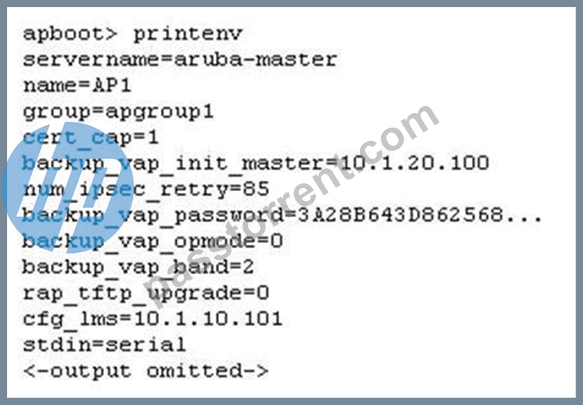
- A. The AP is configured as a RAP to terminate on a Mobility Master.
- B. The AP is configured to terminate on a non-cluster Mobility Controller.
- C. The AP is configured as a RAP to terminate on a stand-alone controller.
- D. The AP is configured to terminate on a Mobility Controller in a cluster.
Answer: B
Explanation:
The AP is configured to terminate on a non-cluster Mobility Controller.
The AP connects to cfg_lms=10.1.10.101.
NEW QUESTION # 32
Refer to the exhibit.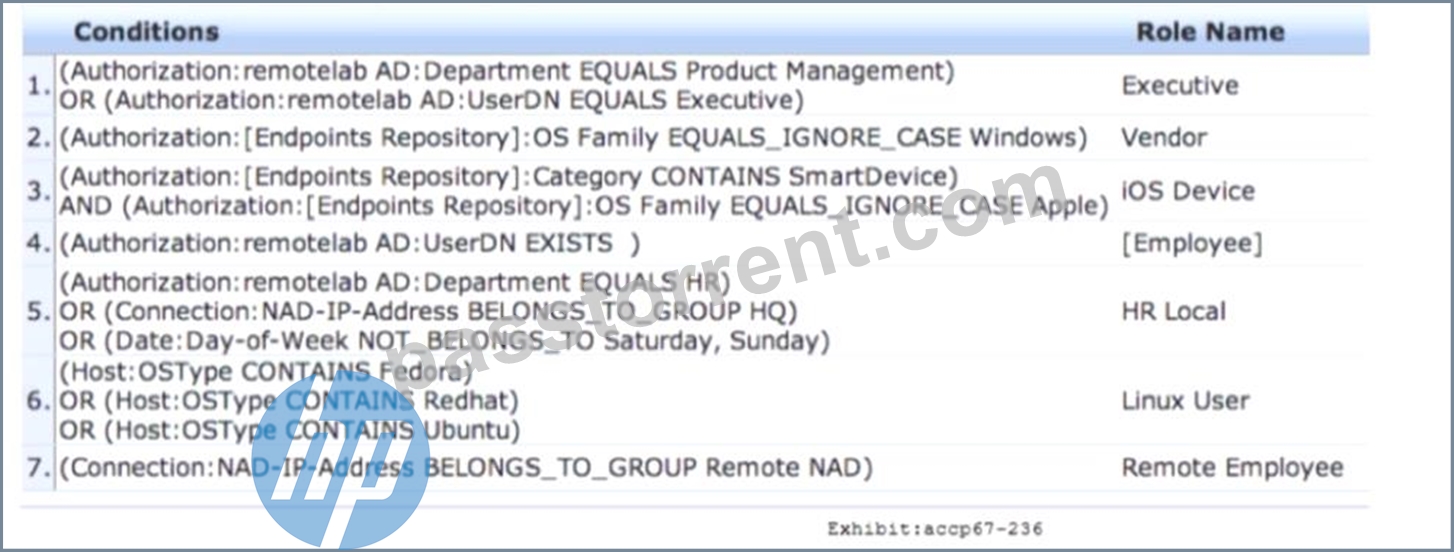
An AD user's department attribute is configured as *HR". The user connects on Monday using their Windows Laptop to a switch that belongs to the Device Group HQ. Which role is assigned to the user in ClearPass?
- A. HR Local
- B. Executive
- C. iOS Device
- D. Remote Employee
- E. Vendor
Answer: A,D
NEW QUESTION # 33
Refer to the exhibit.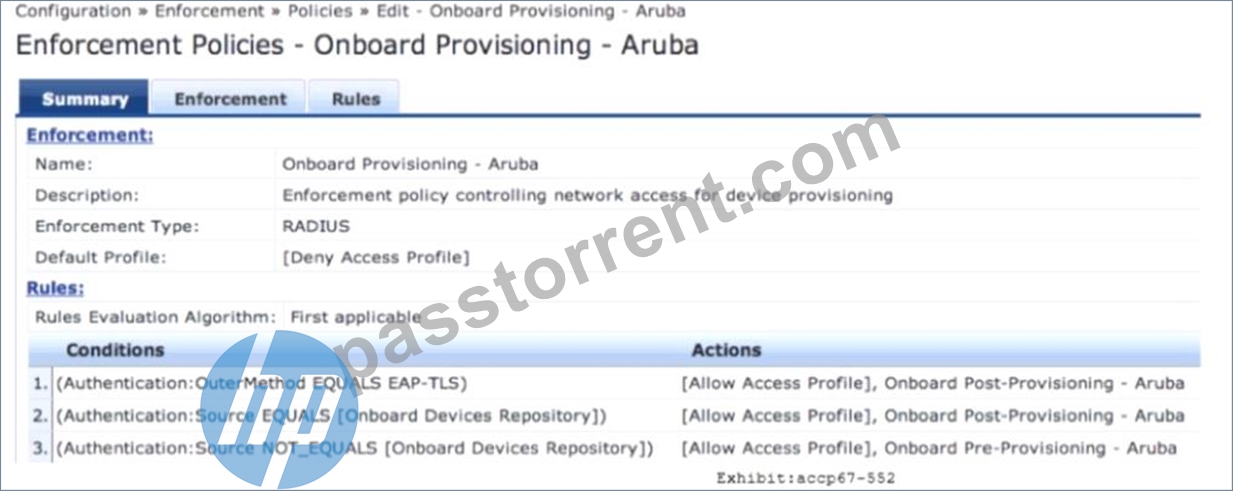
An employee connects a corporate laptop to the network and authenticates for the first time using EAP-TLS. Based on the Enforcement Policy configuration shown, which Enforcement Profile wilt be sent?
- A. Onboard Pre-Provisioning - Aruba
- B. Deny Access Profile
- C. Onboard Device Repository
- D. Onboard Post-Provisioning - Aruba
Answer: A
NEW QUESTION # 34
An administrator deploys an AP at a branch office. The branch office has a private WAN circuit that provides connectivity to a corporate office controller. An Ethernet port on the AP is connected to a network storage device that contains sensitive information. The administrator is concerned about sending this traffic in clear-text across the private WAN circuit.
What can the administrator do to prevent this problem?
- A. Enable IPSec encryption on the AP's wired ports.
- B. Convert the campus AP into a RAP.
- C. Redirect the wired port traffic to an AP-to-controller GRE tunnel.
- D. Enable AP encryption for wired ports.
Answer: A
NEW QUESTION # 35
An administrator configures the MultiZone feature for a company network, where a mobility cluster is the primary zone and a standalone controller in the company's DMZ represents a secondary data zone. The administrator configures two AP Groups and respective VAPs for the zones on the Mobility Master (MM) in the primary zone. When the APs boot up and establish connections to both zones, the administrator notices that no data connections are established to the data zone.
What must the administrator do to fix this problem?
- A. Configure the same AP Groups and VAPs on the standalone controller, and associate the MultiZone APs to both groups.
- B. Configure the same AP Group in the data zone as it is in the primary zone, and configure the VAPs in the data zone.
- C. Create different AP groups and VAPs on the Mobility Master and standalone controllers, and associate the MultiZone APs to both groups.
- D. Have the MultiZone APs initially boot from the standalone controller in the data zone.
Answer: C
NEW QUESTION # 36
Refer to the exhibit.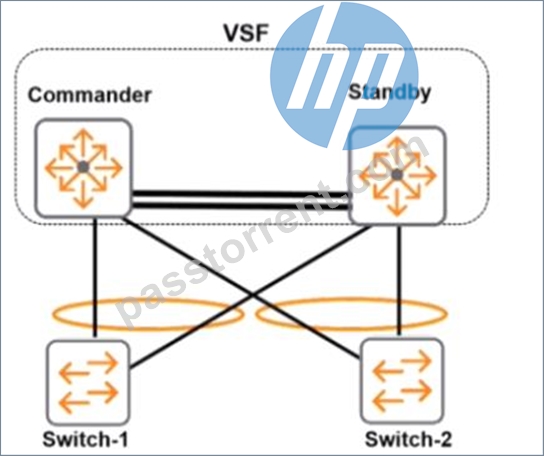
A known unicast packet is received from Switch-1 on the standby and must be forwarded to Switch-2. How does the VSF fabric decide which port in the aggregated (ink should forward the packet?
- A. The standby selects the port on the designated forwarder for the aggregation.
- B. The standby uses its own port in the link aggregation to forward the fabric.
- C. The standby uses the typical load sharing algorithm, and it might select either its port or the commander's port.
- D. The standby sends the packet to the commander over a VSF link, and the commander decides the correct port.
Answer: B
NEW QUESTION # 37
Refer to the exhibit.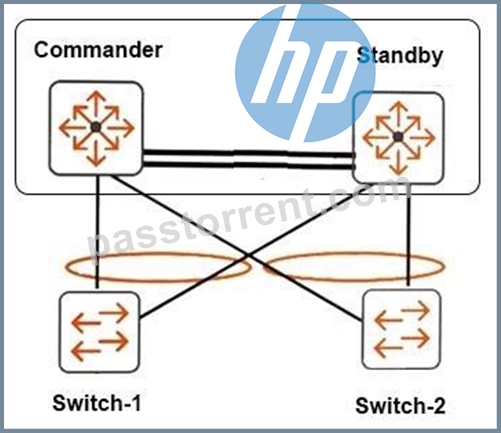
A known unicast packet is received from Switch-1 on the standby and must be forwarded to Switch-2. How does the VSF fabric decide which port in the aggregated (ink should forward the packet?
- A. The standby selects the port on the designated forwarder for the aggregation.
- B. The standby uses its own port in the link aggregation to forward the fabric.
- C. The standby uses the typical load sharing algorithm, and it might select either its port or the commander's port.
- D. The standby sends the packet to the commander over a VSF link, and the commander decides the correct port.
Answer: B
NEW QUESTION # 38
Refer to the exhibit.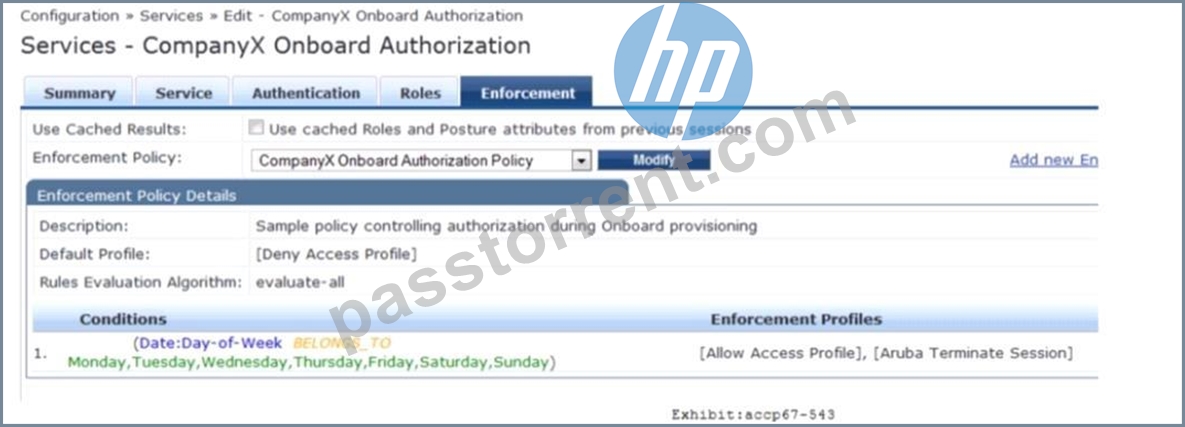
Based on the configuration of the Enforcement Profiles In the Onboard Authorization service shown, which Onboarding action will occur?
- A. The device will be disconnected after post-Onboarding EAP-TLS authentication, so a second EAP- TLS authentication is performed.
- B. The device will be disconnected from the network after Onboarding so that an EAP-TLS authentication is not performed.
- C. The device's onboard authorization request will be denied.
- D. After logging in on the Onboard web login page, the device will be disconnected form and reconnected to the network before Onboard begins.
- E. The device will be disconnected from and reconnected to the network after Onboarding is completed.
Answer: E
NEW QUESTION # 39
Refer to the exhibit.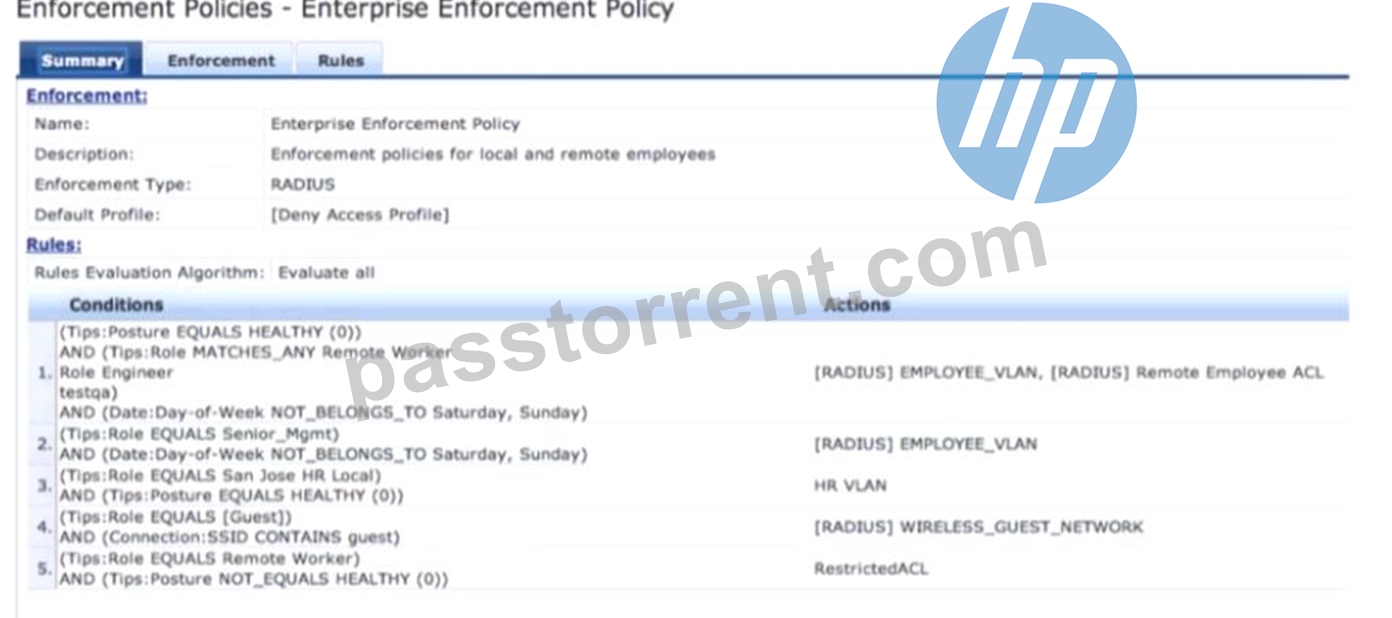
Based on the Enforcement Policy configuration, when a user with Role Engineer connects to the network and the posture token assigned is Unknown, which Enforcement Profile will be applied?
- A. EMPLOYEE_VLAN
- B. Remote Employee ACL
- C. HR VLAN
- D. Deny Access Profile
- E. RestrictedACL
Answer: D
NEW QUESTION # 40
Refer to the exhibit.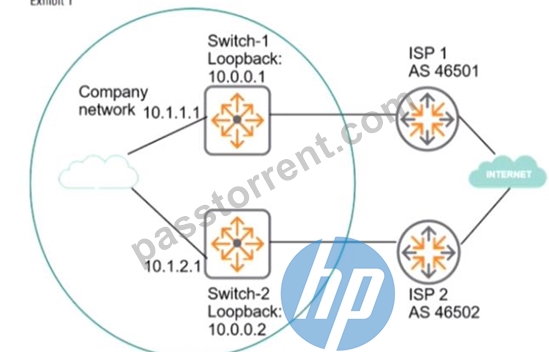
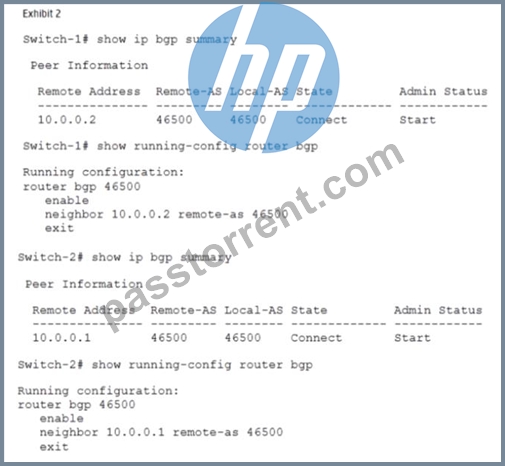
The network administrator needs to set up BGP between the two company switches. Switch-1 and Switch-2. The BGP connection does not establish. Based on the exhibits, what does the administrator need to do to fix the issue?
- A. Enable the multihop option for the neighbor on each of the switches.
- B. Enable BGP on the interfaces that the switches use to reach each other.
- C. Enter the network command for 10.0.0.0/24 in the router BGP mode on each switch.
- D. Set the update source for the neighbor to the local loopback interface on each switch.
Answer: D
NEW QUESTION # 41
A network administrator can set the OSPF metric-type on an AOS-Switch to Type 1 or Type 2.
What is the difference?
- A. A Type 2 metric is assigned to multiple external routes that are aggregated together, while a Type
1 metric does not permit external route aggregation. - B. A Type 2 metric marks external routes that can be advertised in NSSAs, while a Type 1 metric marks external routes that can only be advertised in normal areas.
- C. A Type 2 metric assigns cost 1 to a 100 Gbps link, while a Type 1 metric assigns cost 1 to all links of 100 Mbps or higher.
- D. A Type 2 metric stays the same as the external route is advertised, while a Type 1 metric increments with internal OSPF link costs.
Answer: D
Explanation:
The difference between the two is in the way the cost (metric) of the route is being calculated.
The cost of a type 2 route is always the external cost, irrespective of the interior cost to reach that route. A type 1 cost is the addition of the external cost and the internal cost used to reach that route.
NEW QUESTION # 42
An administrator deploys Aruba Mobility Controller 7005s to a company's branch offices. The administrator wants to disable the console port to prevent unauthorized access to the controllers.
Which controller command should the administrator use to implement this policy?
- A. mgmt-user console-block
- B. no console enable
- C. no mgmt-user console
- D. console disable
Answer: A
NEW QUESTION # 43
Refer to the exhibit.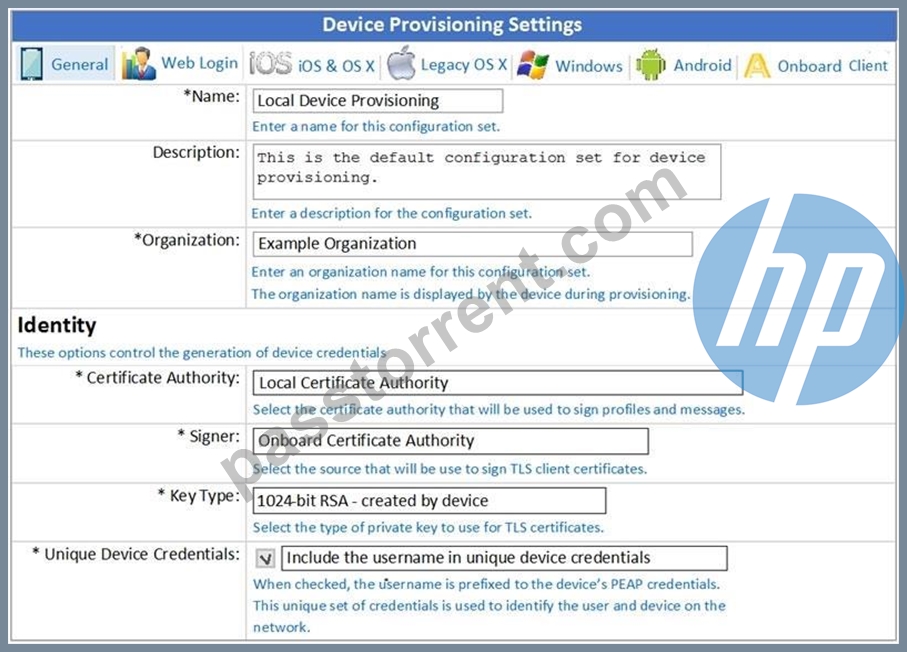
Based on the configuration for the client's certificate private key as shown, which statements accurately describe the settings? (Select two.)
- A. The private key for TLS client certificates is not created.
- B. More bits in the private key will increase security.
- C. The private key is stored in the ClearPass server.
- D. More bits in the private key will reduce security.
- E. The private key is stored in the user device.
Answer: B,E
Explanation:
Private key is mandatory and must be known only by the device, so B and C are false. More bits in the key make it more difficult to guess.
NEW QUESTION # 44
What is a primary use case for RPVST+ on AOS-Switches?
- A. integration of AOS-Switches in a heterogeneous vendor network that uses the Cisco protocol
- B. enhanced loop protection in an MSTP network
- C. seamless integration with RSTP
- D. more granular load balancing than MSTP when access switches connect to two core switches
Answer: A
NEW QUESTION # 45
......
HPE6-A75 exam is designed to test an individual’s knowledge of the Aruba Mobile First Architecture, including ArubaOS-CX switches, ArubaOS switches, and Aruba Instant APs. It also covers the implementation and configuration of Layer 2 and Layer 3 technologies such as VLANs, routing protocols, and Access Control Lists (ACLs). Additionally, it tests knowledge of advanced topics such as Aruba ClearPass, Aruba AirWave, and Aruba Central.
Real HPE6-A75 Quesions Pass Certification Exams Easily: https://www.passtorrent.com/HPE6-A75-latest-torrent.html
Practice with these HPE6-A75 dumps Certification Sample Questions: https://drive.google.com/open?id=1c9famkTnKD-FQuTzRL0TCr39PS23T-Tc