


New 2021 Latest Questions 312-50v11 Dumps - Use Updated EC-COUNCIL Exam
Latest 312-50v11 Exam Dumps EC-COUNCIL Exam from Training Expert PassTorrent
Preparation Process
To have adequate preparation for the EC-Council 312-50v11 exam, you need to look at the following tips:
- Study the CEH Certification Exam Blueprint: You can download the exam blueprint for this test from the official website. It contains the topics and other relevant information that will help you in the preparation and test-taking processes;
- Develop Practical Capability with the Official Training Course: The potential candidates need practical knowledge and skills to ace the test. Therefore, it is recommended to take the official training course, which combines theoretical knowledge and practical skills. It focuses on the details of the domains and equips the individuals with the required expertise to help them ace the exam and prepare for the real-world job tasks;
- Take Practice Tests: To ensure that you gain competence in the exam content, you should evaluate your knowledge and level of preparedness. The best way to do this is to take practice tests during your preparation. Many reputable IT training platforms offer these authentic and genuine tools that you can use to gain the test-taking skills;
- Join a CEH Community: Reading blog posts and participating in the CEH forums will help you connect with the like-minded professionals preparing for the same exam. You can learn from them and gain more insights into the domains of the test. Beyond the exam, you can also build your career network through the community.
Meeting Basic Requirements
Every exam application is subject to approval as there is a specific process to be followed. Applicants who have made it through this procedure will be appearing for 312-50v11 validation. Also, make sure that you have earned a minimum of two years of industry experience before appearing for the official exam. Industry experts also insinuate completing the related training beforehand. To add more, the vendor doesn’t allow anyone below 18 years old to go for this exam. However, if someone is trying to do so, submitting a consent letter by parents or guardians at the ECC testing center is mandatory to proceed further.
NEW QUESTION 63
Bob, a network administrator at BigUniversity, realized that some students are connecting their notebooks in the wired network to have Internet access. In the university campus, there are many Ethernet ports available for professors and authorized visitors but not for students.
He identified this when the IDS alerted for malware activities in the network.
What should Bob do to avoid this problem?
- A. Disable unused ports in the switches
- B. Use the 802.1x protocol
- C. Separate students in a different VLAN
- D. Ask students to use the wireless network
Answer: B
NEW QUESTION 64
which of the following information security controls creates an appealing isolated environment for hackers to prevent them from compromising critical targets while simultaneously gathering information about the hacker?
- A. intrusion detection system
- B. Botnet
- C. Honeypot
Answer: C
Explanation:
D Firewall
Explanation:
A honeypot may be a trap that an IT pro lays for a malicious hacker, hoping that they will interact with it during a way that gives useful intelligence. It's one among the oldest security measures in IT, but beware: luring hackers onto your network, even on an isolated system, are often a dangerous game. honeypot may be a good starting place: "A honeypot may be a computer or computing system intended to mimic likely targets of cyberattacks." Often a honeypot are going to be deliberately configured with known vulnerabilities in situation to form a more tempting or obvious target for attackers. A honeypot won't contain production data or participate in legitimate traffic on your network - that's how you'll tell anything happening within it's a results of an attack. If someone's stopping by, they're up to no good. That definition covers a various array of systems, from bare-bones virtual machines that only offer a couple of vulnerable systems to ornately constructed fake networks spanning multiple servers. and therefore the goals of these who build honeypots can vary widely also , starting from defense thorough to academic research. additionally , there's now an entire marketing category of deception technology that, while not meeting the strict definition of a honeypot, is certainly within the same family. But we'll get thereto during a moment. honeypots aim to permit close analysis of how hackers do their dirty work. The team controlling the honeypot can watch the techniques hackers use to infiltrate systems, escalate privileges, and otherwise run amok through target networks. These sorts of honeypots are found out by security companies, academics, and government agencies looking to look at the threat landscape. Their creators could also be curious about learning what kind of attacks are out there, getting details on how specific sorts of attacks work, or maybe trying to lure a specific hackers within the hopes of tracing the attack back to its source. These systems are often inbuilt fully isolated lab environments, which ensures that any breaches don't end in non-honeypot machines falling prey to attacks. Production honeypots, on the opposite hand, are usually deployed in proximity to some organization's production infrastructure, though measures are taken to isolate it the maximum amount as possible. These honeypots often serve both as bait to distract hackers who could also be trying to interrupt into that organization's network, keeping them faraway from valuable data or services; they will also function a canary within the coalpit , indicating that attacks are underway and are a minimum of partially succeeding.
NEW QUESTION 65
Abel, a security professional, conducts penetration testing in his client organization to check for any security loopholes. He launched an attack on the DHCP servers by broadcasting forged DHCP requests and leased all the DHCP addresses available in the DHCP scope until the server could not issue any more IP addresses. This led to a Dos attack, and as a result, legitimate employees were unable to access the clients network. Which of the following attacks did Abel perform in the above scenario?
- A. Rogue DHCP server attack
- B. DHCP starvation
- C. STP attack
- D. VLAN hopping
Answer: B
Explanation:
Explanation
A DHCP starvation assault is a pernicious computerized assault that objectives DHCP workers. During a DHCP assault, an unfriendly entertainer floods a DHCP worker with false DISCOVER bundles until the DHCP worker debilitates its stock of IP addresses. When that occurs, the aggressor can deny genuine organization clients administration, or even stock an other DHCP association that prompts a Man-in-the-Middle (MITM) assault.
In a DHCP Starvation assault, a threatening entertainer sends a huge load of false DISCOVER parcels until the DHCP worker thinks they've used their accessible pool. Customers searching for IP tends to find that there are no IP addresses for them, and they're refused assistance. Furthermore, they may search for an alternate DHCP worker, one which the unfriendly entertainer may give. What's more, utilizing a threatening or sham IP address, that unfriendly entertainer would now be able to peruse all the traffic that customer sends and gets.
In an unfriendly climate, where we have a malevolent machine running some sort of an instrument like Yersinia, there could be a machine that sends DHCP DISCOVER bundles. This malevolent customer doesn't send a modest bunch - it sends a great many vindictive DISCOVER bundles utilizing sham, made-up MAC addresses as the source MAC address for each solicitation.
In the event that the DHCP worker reacts to every one of these false DHCP DISCOVER parcels, the whole IP address pool could be exhausted, and that DHCP worker could trust it has no more IP delivers to bring to the table to legitimate DHCP demands.
When a DHCP worker has no more IP delivers to bring to the table, ordinarily the following thing to happen would be for the aggressor to get their own DHCP worker. This maverick DHCP worker at that point starts giving out IP addresses.
The advantage of that to the assailant is that if a false DHCP worker is distributing IP addresses, including default DNS and door data, customers who utilize those IP delivers and begin to utilize that default passage would now be able to be directed through the aggressor's machine. That is all that an unfriendly entertainer requires to play out a man-in-the-center (MITM) assault.
NEW QUESTION 66
Taylor, a security professional, uses a tool to monitor her company's website, analyze the website's traffic, and track the geographical location of the users visiting the company's website.
Which of the following tools did Taylor employ in the above scenario?
- A. WAFW00F
- B. WebSite-Watcher
- C. Web-Stat
- D. Webroot
Answer: C
NEW QUESTION 67
Your company performs penetration tests and security assessments for small and medium-sized business in the local are a. During a routine security assessment, you discover information that suggests your client is involved with human trafficking.
What should you do?
- A. Immediately stop work and contact the proper legal authorities.
- B. Confront the client in a respectful manner and ask her about the data.
- C. Ignore the data and continue the assessment until completed as agreed.
- D. Copy the data to removable media and keep it in case you need it.
Answer: A
NEW QUESTION 68
You are analysing traffic on the network with Wireshark. You want to routinely run a cron job which will run the capture against a specific set of IPs - 192.168.8.0/24. What command you would use?
- A. sudo tshark -f''net 192 .68.8.0/24''
- B. wireshark --fetch ''192.168.8*''
- C. wireshark --capture --local masked 192.168.8.0 ---range 24
- D. tshark -net 192.255.255.255 mask 192.168.8.0
Answer: A
NEW QUESTION 69
Clark, a professional hacker, was hired by an organization lo gather sensitive Information about its competitors surreptitiously. Clark gathers the server IP address of the target organization using Whole footprinting. Further, he entered the server IP address as an input to an online tool to retrieve information such as the network range of the target organization and to identify the network topology and operating system used in the network. What is the online tool employed by Clark in the above scenario?
- A. AOL
- B. DuckDuckGo
- C. ARIN
- D. Baidu
Answer: C
NEW QUESTION 70
which of the following Bluetooth hacking techniques refers to the theft of information from a wireless device through Bluetooth?
- A. Bluesmacking
- B. Bluesnarfing
- C. Bluebugging
- D. Bluejacking
Answer: D
Explanation:
Explanation
Bluejacking is maybe the foremost common sort of Bluetooth hacking. This happens once a hacker searches for discoverable devices within the space and so sends spam within the sort of text messages to the devices.
this manner of hacking is very immature and harmless.
It was once used primarily to prank individuals within the past once mobile devices came with Bluetooth that was mechanically set to ascertainable. Bluejacking is employed nowadays for spam electronic communication and also the hackers World Health Organization use this bonk simply to frustrate others. the tactic doesn't offer hackers access to your phone or the knowledge on that.
The best thanks to alter Bluejacking is to ignore the messages if you receive them. If you retain your Bluetooth settings to "invisible" or "non-discoverable" you're not going to receive these messages. Also, keeping your smartphone or device set to "invisible" whereas you're in a very busy or open Wi-Fi space. this can forestall Bluejacking and also the next 2 well-liked styles of hacks.
NEW QUESTION 71
Study the following log extract and identify the attack.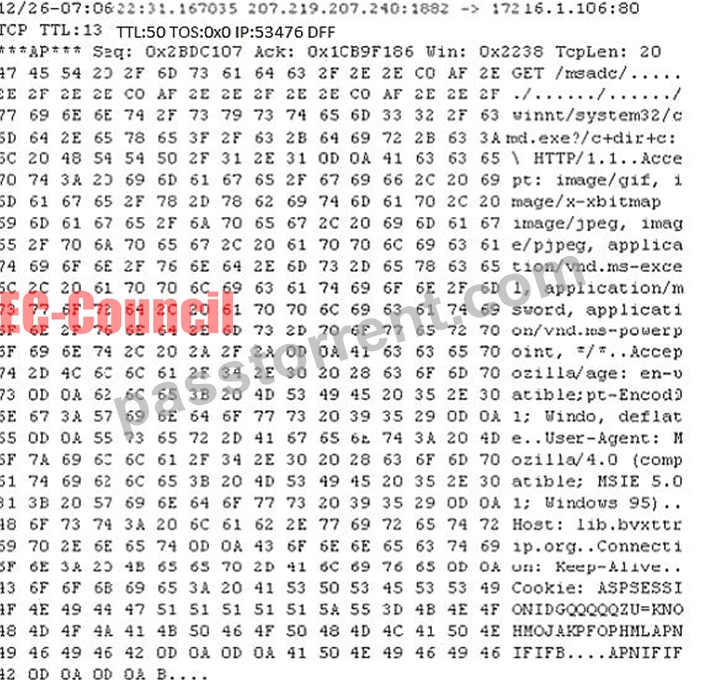
- A. Hexcode Attack
- B. Cross Site Scripting
- C. Multiple Domain Traversal Attack
- D. Unicode Directory Traversal Attack
Answer: D
NEW QUESTION 72
Clark, a professional hacker, was hired by an organization lo gather sensitive Information about its competitors surreptitiously. Clark gathers the server IP address of the target organization using Whole footprinting.
Further, he entered the server IP address as an input to an online tool to retrieve information such as the network range of the target organization and to identify the network topology and operating system used in the network. What is the online tool employed by Clark in the above scenario?
- A. AOL
- B. DuckDuckGo
- C. ARIN
- D. Baidu
Answer: B
NEW QUESTION 73
Taylor, a security professional, uses a tool to monitor her company's website, analyze the website's traffic, and track the geographical location of the users visiting the company's website. Which of the following tools did Taylor employ in the above scenario?
- A. WAFW00F
- B. web-Stat
- C. WebSite Watcher
- D. Webroot
Answer: B
Explanation:
Increase your web site's performance and grow! Add Web-Stat to your site (it's free!) and watch individuals act together with your pages in real time.
Learn how individuals realize your web site. Get details concerning every visitor's path through your web site and track pages that flip browsers into consumers.
One-click install. observe locations, in operation systems, browsers and screen sizes and obtain alerts for new guests and conversions
NEW QUESTION 74
John, a professional hacker, targeted CyberSol Inc., an MNC. He decided to discover the loT devices connected in the target network that are using default credentials and are vulnerable to various hijacking attacks. For this purpose, he used an automated tool to scan the target network for specific types of loT devices and detect whether they are using the default, factory-set credentials. What is the tool employed by John in the above scenario?
- A. Azure loT Central
- B. loT Inspector
- C. loTSeeker
- D. AT&T loT Platform
Answer: C
NEW QUESTION 75
Gregory, a professional penetration tester working at Sys Security Ltd., is tasked with performing a security test of web applications used in the company. For this purpose, Gregory uses a tool to test for any security loopholes by hijacking a session between a client and server. This tool has a feature of intercepting proxy that can be used to inspect and modify the traffic between the browser and target application. This tool can also perform customized attacks and can be used to test the randomness of session tokens. Which of the following tools is used by Gregory in the above scenario?
- A. Nmap
- B. Wireshark
- C. CxSAST
- D. Burp Suite
Answer: D
NEW QUESTION 76
Attacker Lauren has gained the credentials of an organization's internal server system, and she was often logging in during irregular times to monitor the network activities. The organization was skeptical about the login times and appointed security professional Robert to determine the issue. Robert analyzed the compromised device to find incident details such as the type of attack, its severity, target, impact, method of propagation, and vulnerabilities exploited. What is the incident handling and response (IH&R) phase, in which Robert has determined these issues?
- A. Incident triage
- B. Eradication
- C. Preparation
- D. Incident recording and assignment
Answer: A
Explanation:
Triage is that the initial post-detection incident response method any responder can execute to open an event or false positive. Structuring an efficient and correct triage method can reduce analyst fatigue, reduce time to reply to and right incidents, and ensure that solely valid alerts are promoted to "investigation or incident" status.
Every part of the triage method should be performed with urgency, as each second counts once in the inside of a crisis. However, triage responders face the intense challenge of filtering an unwieldy input supply into a condensed trickle of events. Here are some suggestions for expediting analysis before knowledge is validated:
Organization: reduce redundant analysis by developing a workflow that may assign tasks to responders. Avoid sharing an email box or email alias between multiple responders. Instead use a workflow tool, like those in security orchestration, automation, and response (SOAR) solutions, to assign tasks. Implement a method to re-assign or reject tasks that are out of scope for triage.
Correlation: Use a tool like a security info and even management (SIEM) to mix similar events. Link potentially connected events into one useful event.
Data Enrichment: automate common queries your responders perform daily, like reverse DNS lookups, threat intelligence lookups, and IP/domain mapping. Add this knowledge to the event record or make it simply accessible.
Moving full speed ahead is that the thanks to get through the initial sorting method however a a lot of detailed, measured approach is necessary throughout event verification. Presenting a robust case to be accurately evaluated by your security operations center (SOC) or cyber incident response team (CIRT) analysts is key. Here are many tips for the verification:
Adjacent Data: Check the data adjacent to the event. for example, if an end has a virus signature hit, look to visualize if there's proof the virus is running before career for more response metrics.
Intelligence Review: understand the context around the intelligence. simply because an ip address was flagged as a part of a botnet last week doesn't mean it still is an element of a botnet today.
Initial Priority: Align with operational incident priorities and classify incidents appropriately. ensure the right level of effort is applied to every incident.
Cross Analysis: look for and analyze potentially shared keys, like science addresses or domain names, across multiple knowledge sources for higher knowledge acurity.
NEW QUESTION 77
You are a penetration tester working to test the user awareness of the employees of the client xyz. You harvested two employees' emails from some public sources and are creating a client-side backdoor to send it to the employees via email. Which stage of the cyber kill chain are you at?
- A. Command and control
- B. Weaponization
- C. Exploitation
- D. Reconnaissance
Answer: B
Explanation:
Explanation
Weaponization
The adversary analyzes the data collected in the previous stage to identify the vulnerabilities and techniques that can exploit and gain unauthorized access to the target organization. Based on the vulnerabilities identified during analysis, the adversary selects or creates a tailored deliverable malicious payload (remote-access malware weapon) using an exploit and a backdoor to send it to the victim. An adversary may target specific network devices, operating systems, endpoint devices, or even individuals within the organization to carry out their attack. For example, the adversary may send a phishing email to an employee of the target organization, which may include a malicious attachment such as a virus or worm that, when downloaded, installs a backdoor on the system that allows remote access to the adversary. The following are the activities of the adversary: o Identifying appropriate malware payload based on the analysis o Creating a new malware payload or selecting, reusing, modifying the available malware payloads based on the identified vulnerability o Creating a phishing email campaign o Leveraging exploit kits and botnets
NEW QUESTION 78
What hacking attack is challenge/response authentication used to prevent?
- A. Scanning attacks
- B. Replay attacks
- C. Password cracking attacks
- D. Session hijacking attacks
Answer: B
NEW QUESTION 79
What is the following command used for?
sqlmap.py-u
,,http://10.10.1.20/?p=1
&forumaction=search" -dbs
- A. Creating backdoors using SQL injection
- B. Retrieving SQL statements being executed on the database
- C. A Enumerating the databases in the DBMS for the URL
- D. Searching database statements at the IP address given
Answer: A
NEW QUESTION 80
......
The EC-Council 312-50v11 exam is designed for the evaluation of the individuals’ knowledge of the latest commercial-grade hacking methodologies, techniques, and tools utilized by the information security professionals and hackers to legally hack the organizations. The associated certification is Certified Ethical Hacker CEH v11. It is one of the most popular options in the domain of hacking for the IS specialists. This certificate covers twenty core modules, which include an introduction to ethical hacking, scanning networks, malware threats, system hacking, vulnerability analysis, as well as footprinting & reconnaissance. It also covers the areas, such as sniffing, denial-of-service, social engineering, hacking web applications, hacking wireless networks, SQL injection, Cloud computing, hacking mobile platforms, cryptography, and IoT hacking.
Updated Test Engine to Practice 312-50v11 Dumps & Practice Exam: https://www.passtorrent.com/312-50v11-latest-torrent.html
Pass EC-COUNCIL 312-50v11 PDF Dumps Recently Updated 525 Questions: https://drive.google.com/open?id=1e38yiTLx9m6J_qXUbhFMUu1m9fXgYTD_