


L4M5 Actual Questions Answers Pass With Real L4M5 Exam Dumps
L4M5 Dumps Prepare Your Exam With 225 Questions
NEW QUESTION # 71
Which of the following are factors that might shift the demand curve for a consumer good to the right?
1. Prices of complementary goods decrease
2. Price of the consumer good decreases
3. Customers' expectation of higher prices in the future
4. Consumer tastes shift toward substitute products
- A. 1 and 3 only
- B. 4 and 2 only
- C. 3 and 4 only
- D. 1 and 2 only
Answer: A
Explanation:
Explanation
A shift in demand occurs when an influencing factor other than price changes. Those factors are:
- The income ofbuyers
- The tastes and preferences of buyers
- The prices of other goods and services, especially substitutes and complements
- Expectations of buyer about the future
In this question:
- 'Prices of complementary goods decrease' will lead toquantity demanded for that complements rising, then demand for consumer good will increase accordingly.
- 'Price of the consumer good decreases' will increase the quantity demanded for that good, but it will not shift the demand curve
- 'Customers' expectation of higher prices in the future': in this scenario, customers tend to buy more to store in present, which leads to demand curve shifting to the right
- 'Consumer tastes shift toward substitute products': Demand for substitutes will rise, so demand forthat consumer good will decrease and the demand curve shifts to the left.
LO 2, AC 2.2
NEW QUESTION # 72
Which of the following is categorised as fixed cost?
- A. Land rental paid in advance
- B. Governments taxes
- C. Additional pallet hires due to higher demand in year-end season
- D. Raw materials for next year production
Answer: A
Explanation:
Anorganisation's expense can be categorised into three groups:
Fixed Costs - costs that do not change with output.
Variable Costs - costs that vary in direct proportion to output.
Semi-variable costs - costs that are a combination of the above, with both a fixed and variable element.
Among the four options:
"Land rental paid in advance": This is fixed cost. The rental won't increase when the production increases.
"Additional pallet hires due to higher demand in year-end season": This can be identified as semi-variable cost (or step cost).
"Governments taxes": The taxes are often levied by a percentage of income or revenue. Therefore, it is variable
"Raw materials for next year production": This is obviously variable cost.
NEW QUESTION # 73
Which of the following is the most appropriate pricing arrangement in contracts where major inputs are commodities?
- A. Fixed pricing arrangement
- B. Standard schedule of rates
- C. Cost reimbursable pricingarrangement
- D. Price adjustment mechanism
Answer: D
Explanation:
In contracts which have major commodity input, the price is determined by market forces with no individual supplier or buyer able to influence it significantly.Prices are much more variable even within long term contracts and seeking a fixed price would create financial risks for both the buyers and the suppliers. It is often intelligent to agree a contract price adjustment mechanism to allow for market price changes so both sides share risk.
NEW QUESTION # 74
JCB is a large manufacturer of heavy machinery. The CPO is going to a negotiation with a Chinese supplier about procuring some major components. He is wondering about balance of power in the negotiation. Which of the following micro factors are most likely to shift the balance of power towards the buying organisation in this commercial negotiation? Select TWO that apply
- A. Buyers purchase in small volumes
- B. These components are highly standardised
- C. JCB's switching costs are low
- D. Suppliers are more concentrated than buyer
- E. Eruption of epidemic in supply market
Answer: B,C
Explanation:
Explanation
There are many factors that can influence the balance of power in a negotiation. These factors are classified into 3 levels:
- Macro level: STEEPLE framework: social, technological, economic, environment, political, legal and ethical
- Micro level: Porter's five forces: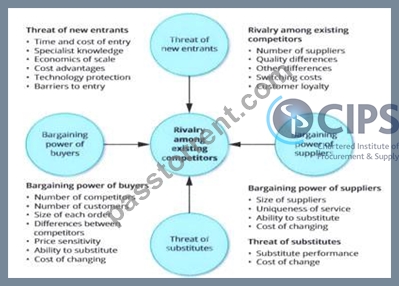
Diagram Description automatically generated
- One-to-one buyer-supplier dynamics.
The question asks about the micro factors that increases buyer's bargaining power. Among 5 answers, only 2 are likely to increase buyer'spower:
- JCB's switching costs are low: Buyer may easily switch its suppliers anytime
- These components are highly standardised: The products are not different any more, buyer may choose to buy from any supplier available.
Other answers cannot be correctbecause:
- Suppliers are more concentrated than buyer: Suppliers are forming oligopoly market, their bargaining power tend to be greater.
- Eruption of epidemic in supply market: this is a macro factor. Eruption of epidemic may cause factories closed and disruptions on supply chain.
- Buyers purchase in small volumes: Buyer will be seen as less potential to suppliers. Buying organisation may have difficulties to deal better price with suppliers.
LO 1, AC 1.3
NEW QUESTION # 75
Which of the following are most likely to be characteristics of a perfectly competitive market? Select TWO that apply
- A. In a perfectly competitive market, each seller has a large impact on the market price A perfectly competitive market consists of products that are all slightly different from one another
- B. In a competitive market, both buyers and sellers areprice givers
- C. Firms can freely enter or exit the market
- D. There are many buyers and sellers in the market
Answer: C,D
Explanation:
Explanation
A perfectly competitive market is one with the following features:
- There are many firms producing identical or very similar (homogeneous) goods or services
- There are no barriers toentry to the market or exit from the market - anyone can enter or leave easily
- Both producers and customers have perfect knowledge of the market place, prices, costs of production and influences on demand and supply Under these conditions, the price andquantity will always tend toward equilibrium as any producer that sets a price above equilibrium will not sell anything at all, and any producer that sets a price below a equilibrium will obtain 100% market share in theory. The demand curve is perfectly elastic, which means that it will be horizontal. In a perfectly competitive market, it is difficult to increase profits through pricing, and suppliers instead must focus on their cost structure. As these conditions imply, there are few if any examples of perfectly competitive market.
LO 2, AC 2.2
NEW QUESTION # 76
What is the most likely outcome when two organisations with adversarial relationship negotiate with each other?
- A. Lose lose
- B. Win lose
- C. Deadlocked
- D. Win win
Answer: B
Explanation:
An adversarial relationship in purchasing and supply arises when identical or equivalent good or services are available from competing suppliers and buyers/sellers are trying to gain an advantage over each other. Low levels of trust are characteristic of adversarial relationships. The outcome when two organisations with adversarial negotiate is most likely to be win-lose.
NEW QUESTION # 77
Which of the following are examples of push techniques in commercial negotiations? Select TWO that apply.
- A. Threat of punishment, costs and damage
- B. Working together to define the problem, the goals and the best solution
- C. Listening to, involving andsupporting others
- D. Using language and imagery to 'paint a picture others can see'
- E. Argument based on information, logic and reason
Answer: A,E
Explanation:
There are two major persuasion methods: 'push' and 'pull'.
Persuasion can be defined as encouraging someone to do something that you want them to do for you.
Persuasion is reasoning with someone so that they will believe or do something they might not otherwise do.
Persuasion can be considered as 'pushing' on TOP so that they can accept the change in attitude or behaviour as a result of your actions.
Influence is the ability to affect the manner of thinking of another. Influence can be considered as pulling on TOP so that you achieve the same result, but TOP feels they have changed their attitude or behaviour as a result of their reflection and thinking, and not your direct actions.
There are 5 options in this question:
'Threat of punishment, costs and damage': The influencertries to 'push' the other party to act as he/she wants by using force. This method is effective but short-lived. The influencer also risks to developing reputation for being heavy handed and dictatorial.
'Argument based on information, logic and reason':The influencer uses logic and reasons to persuade the other party. This is also known as 'Persuasive Reasoning' (Push)
'Using language and imagery to 'paint a picture others can see'': The influencer seeks to influence another by understanding the other'semotions, and stimulating that party's imagination to visualise the desired future goal of the influencer. This is also known as 'visionary (pull)'
'Working together to define the problem, the goals and the best solution': In this technique, the person seeking to influence another involves the other party in the decision making process. This is known as 'collaborative (pull)'
'Listening to, involving and supporting others': In this technique, the person seeking to influence another tries to discover the other party's emotion and aims at mutual understanding. This is also a collaborative approach.
NEW QUESTION # 78
An experienced procurement professional is developing strategies for forthcoming negotiations with her key supplier. To avoid negotiation deadlocks, she identifies the reasons why negotiations could fail. Which of the following are most likely to be reasons for negotiation failures? Select TWO that apply.
- A. Buyer helps to create a co-operative atmosphere
- B. Underlying interests of TOP are overlooked
- C. Unachievable objectives were set up
- D. MIL objectives are well established
- E. Both parties focus on common interests
Answer: B,C
Explanation:
:
It has been said that most negotiations are won (or lost) at the preparation stage. Success in a negotiation cannot be claimed unless you can refer back to your objectives and show how you have achieve them. In broad terms, negotiation plans/strategies involve 4 key activities:
1. Developing and prioritising your objectives and limits
2. Seeking to understand TOP's objectives
3. Developing concession plans
4. Planning the resources and logistics required and agreeing team roles.
Questions to gain an understanding of why a negotiation failed
Did we collect and make effective use of all information available when preparing for the negotiation?
Did we set objectives for the negotiation that were stretching and achievable and established MIL objectives?
Did we determine a strategy for the negotiation?
Did the other party understand our needs correctly?
Were we aware of the underlying interests of the other party?
Were our proposals convincing enough for acceptance by the other party?
Did we explore different variables in the negotiation?
Did we fully understand all proposals?
Did we give any unplanned concessions and did we check the importance of these?
Did we focus on common interests?
Did we ask a range of questions?
Did we get answers to all our questions?
Could we answer all the questions addressed to us in a proper and positive way?
Did we summarise effectively?
Did we use different methods of persuasion in the negotiations?
Which tactics did we use and what effect did they have?
Did our negotiating team work well as a team?
Did we help to create a co-operative atmosphere
NEW QUESTION # 79
In addition to organisational power, personal power of each negotiator can influence the outcomes of a negotiation. A good negotiator can leverage different sources of power. Is this statement true?
- A. Yes, because the good negotiator recognises his own power in a negotiation
- B. No, because each person has only one superior source of personal power
- C. Yes, because allsources of power have similar effectiveness in every situation
- D. No, because only organisational power can be leveraged during a negotiation
Answer: A
Explanation:
Explanation
Both organisational and personal power have the ability to influence the outcomes of negotiation. Good negotiators recognises the different sources of relative personal power they possess in a negotiation. There is no one superior source of personal power; they will vary in their effectiveness based on the situation. The more personal sources available the better, even if some not used, these can be used as a fallback.
LO 1, AC 1.3
NEW QUESTION # 80
Katie is preparing a negotiation with a strategic supplier. Through deep market analysis, she realises that her company and the supplier have equal bargaining power. Via regular communication, Katie knows that both parties are arguing on amount of liquidated damages and neither party shall concede all of their requirements but some are negotiable. Katie and her counterpart from supplying company still desire a long-term relationship and hope that the meeting between them will be a solution for current situation. Which of the following is the most appropriate approach that Katie should adopt to achieve the above outcome?
- A. Compromising approach
- B. Accommodating approach
- C. Competing approach
- D. Avoiding approach
Answer: A
Explanation:
Competing is assertive and uncooperative, a power-oriented mode. When competing, an individual pursues his or her own concerns at the other person's expense, using whatever power seems appropriate to win his or her position. Competing might mean standing up for your rights, defending a position you believe is correct, or simply trying to win. Competing will not allow long-term relationship to flourish.
Compromising is intermediate in both assertiveness and cooperativeness. When compromising, the objective is to find an expedient, mutually acceptable solution that partially satisfies both parties. Compromising falls on a middle ground between competing and accommodating, giving up more than competing but less than accommodating. Likewise, it addresses an issue more directly than avoiding but doesn't explore it in as much depth as collaborating. Compromising might mean splitting the difference, exchanging concessions, or seeking a quick middle-ground position. It is a valid approach when long-term relationships are at stake and it is important to find some common ground on which to base an agreement. Both sides get something but not everything. Therefore, this is the most appropriate for this scenario.
Avoiding is unassertive and uncooperative. When avoiding, an individual does not immediately pursue his or her own concerns or those of the other person. He or she does not address the conflict. Avoiding might take the form of diplomatically sidestepping an issue, postponing an issue until a better time, or simply withdrawing from a threatening situation. In the scenario, both parties want to take the opportunity, then avoiding is not an appropriate solution.
Accommodating is unassertive and cooperative-the opposite of competing. When accommodating, an individual neglects his or her own concerns to satisfy the concerns of the other person; there is an element of self-sacrifice in this mode. Accommodating might take the form of selfless generosity or charity, obeying another person's order when you would prefer not to, or yielding to another's point of view. In the scenario, neither party shall concede all of their requirements, it is unnecessary to adopt this approach.
LO 1, AC 1.1
NEW QUESTION # 81
Which of the following are intangible values created by trust in business relationships? Select TWO that apply.
- A. Higher revenues
- B. Frequent conflict escalation
- C. Increasing response time to request
- D. Positive feedbacks from customers
- E. More focus oncore business
Answer: D,E
Explanation:
Explanation
Trust may create value as following:
Text Description automatically generated with low confidence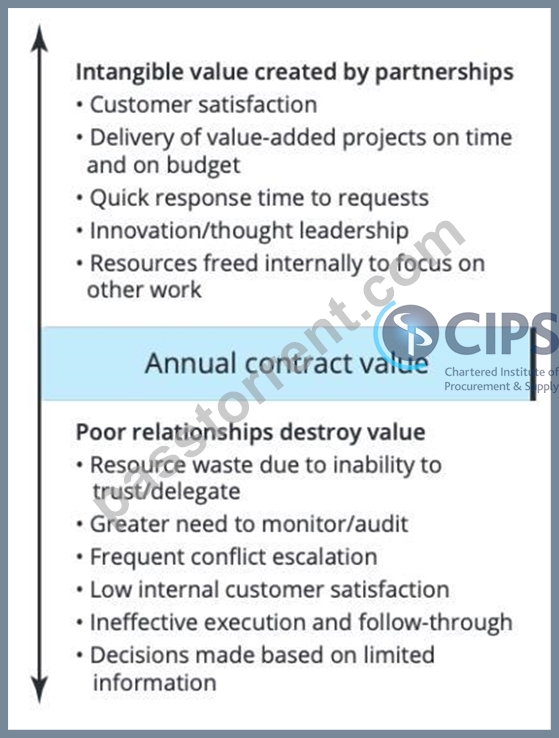
LO 1, AC 1.4
NEW QUESTION # 82
Should a buyer use closed questions in a negotiation?
- A. Yes, because they urge the supplier to provide more detailedExplanation::
- B. Yes, because closed questions help to reconfirm certain facts
- C. No, the buyer should maximise the use of open questions
- D. No, supplier will consider closed questions as provocation
Answer: B
Explanation:
Asking questions the right way is both an art and a science. Ask the question the wrong way, and the other negotiator might act like a turtle, becoming defensive and withdrawing into their shell. Ask the question the right way, and the other negotiator might "spill the beans.".
Closed Questions: How and when to use them?
Closed questions are those thatrequire a short and focused answer, and are especially helpful in the beginning stages of the negotiation to encourage interaction. They can be used to clarify a point, or to reconfirm certain facts. For example, you can use a closed question to confirm the amount of units the company can produce in a week, or to clarify that what they are really saying is that they don't feel comfortable outsourcing their accounts to India. Most closed questions only require a simple "yes" or "no" response, so there reallyisn't much room for misinterpretation - great for finding out where both you and they stand.
NEW QUESTION # 83
Which of the following are examples of variable costs?
Building and site rent
Annual insurance premium
Raw materials expenditure
Delivery costs for materials
- A. 3 and 4
- B. 1 and 4
- C. 2 and 3
- D. 1 and 3
Answer: A
Explanation:
Raw materials expenditure (3) and delivery costs for materials (4) are variable costs as they fluctuate with production levels. Variable costs vary directly with the volume of production, unlike fixed costs such as rent or insurance, in line with CIPS's classifications of cost types in procurement.
NEW QUESTION # 84
Which of the following are recognised techniques in contract negotiation? Select THREE that apply.
- A. Anchoring
- B. Role ethics
- C. Validation
- D. Framing and reframing
- E. Ratification
- F. Pacing and leading
Answer: A,D,F
Explanation:
Explanation
The question asks about negotiation techniques which are not present in the book. In this question, there are only 3 recognised techniques:
- Framing and reframing: A frame is an assumption, or set of assumptions, that guides our attention and behavior. Reframing is the ability to identify and significantly change assumptions or perspectives. Framing has a significant impact on the effectiveness of negotiation outcomes and negotiator working relationships.
You can read more on framing and reframing here.
- Anchoring: Anchoring bias is well-known cognitive bias in negotiation and in other contexts. The anchoring bias describes the common tendency to give too much weight to the first number put forth in a discussion and then inadequately adjust from that starting point, or the "anchor." We even fixate on anchors when we know they are irrelevant to the discussion at hand. You can read more on anchoring here.
- Pacing and leading: Pacing and leading is a two-step lever of persuasion. First - You "match your pace" to the person you want to influence in as many ways as possible. You can do this by mimicking the way the person talks, stands, their appearance, etc. You can also mimic less tangible aspects like the way they act, or their emotional state.Second - Once you've set your pace with someone, lead them to whatever decision or behavior you want them to take! You can read more on pacing and leading here.
NEW QUESTION # 85
Collaborative approach in negotiation not only can fully satisfies the concerns of both, but also ensure that neither party will seek to be opportunistic in later time during the life of the contract. Is this statement true?
- A. Yes, because both parties have well understood each other's goals when they engage in collaborative negotiation
- B. No, because the parties will always find a compromise solution in integrative approach
- C. Yes, because all parties must have exactly the same goals in integrative negotiation
- D. No, because any party may leverage its own advantage during the contract
Answer: D
Explanation:
:
Integrative, interest-based negotiation can facilitate constructive, positive relationship and establish contracts between parties on a foundation of goodwill. It is important to note it can only facilitate these positive outcomes, it does not guarantee that the other party will not seek to be opportunistic at a later time during the life of the contract. Previous knowledge of the behaviours of the other party regarding honouring contractual and other commitments will be useful here in predicting long-term outcomes, not ensuring that they will not leverage their advantages.
NEW QUESTION # 86
A negotiation is coming to the end. Both parties haven't had any official commitments. Right before leaving the room, the buyer strongly disagrees with supplier's set up prices and requests a discount. The supplier doesn't reply but nods and smiles. Can the buyer consider these actions as an acceptance?
- A. Yes, because smiling shows supplier's readiness in signing the deal off
- B. No, because nodding and smiling are etiquette of polite rejection
- C. No, because nodding and smiling are not clear signs of neither acceptance nor rejection
- D. Yes, because negotiator should rely on non-verbal communications only
Answer: C
Explanation:
Good negotiators are attuned to all stimuli and not just the verbal and written information exchanged. Tone of voice, body language, facial expressions and other clues from TOP are noticed, and with experience and knowledge, interpreted correctly. This interpretation may also involve knowledge of culture norms and values.
A smile, a 'yes' and the type of hospitality received, (in thebusiness context), can mean very different things in different international business cultures.
Trained negotiators will consider non-verbal communication (such as nodding and smiling) and body language as one source of signal from TOP, but will rarely rely wholly on this as a guide to what TOP is thinking or feeling. Furthermore, international and regional cultural considerations must be included here to avoid errors in interpretation. Emotional intelligence also has an important role in forming a more holistic perspective of what TOP may be thinking or feeling.
NEW QUESTION # 87
Which of the following is considered a weakness of a 'dealer' style negotiator?
- A. Focuses on the facts and not the people
- B. May be too assertive
- C. Very precise
- D. May shift position quickly
Answer: D
Explanation:
A useful and simple shorthand for preferred negotiation styles is summarised by four simple descriptor:
'warm', 'tough', 'logical' and 'dealer', which can be applied to describe individuals' dominant preferred style in most circumstances.
Warm - a people person
Tough - a hard-nosed negotiator
Logic - a numbers person
Dealer - a trader who loves bargaining
Strengths, weaknesses of dealer style are described below:
Table Description automatically generated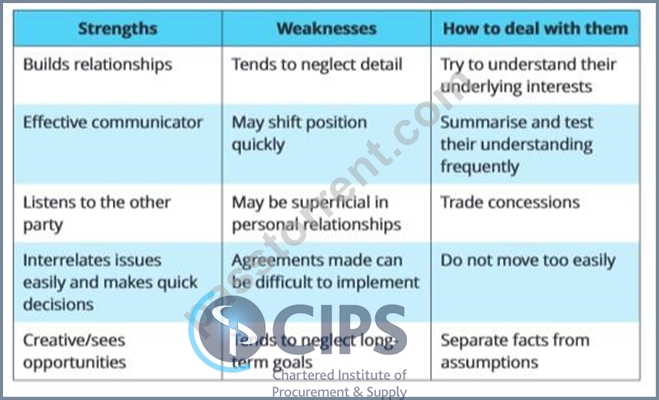
LO 2, AC 2.4
NEW QUESTION # 88
Which of the following is active listening?
- A. Summarising what has been said
- B. Ignoring what the other party has to say
- C. Encouraging the other party to do all the talking
- D. Agreeing with what the other party has to say
Answer: A
Explanation:
Summarising what has been said is a key component of active listening, as it demonstrates understanding and engagement in the conversation. Active listening involves confirming and clarifying information, which helps build rapport and ensures accurate communication, as outlined in CIPS's guidelines for effective negotiation communication.
NEW QUESTION # 89
An oil refinery plant imports much of its crude oil from overseas. A procurement manager in the refinery suggests that fixing the crude oil contract price for 36 months would be beneficial for the company. Would this be a right thing to do?
- A. Yes, financial budgeting task would be a lot easier with fixed pricing arrangement
- B. No, fixed price should be only applied to contracts that last 60 months or longer
- C. No, the refinery would not be able to reap the benefits from falling commodity price and currency rates
- D. Yes, the supplier would bear the risk when the material price increased
Answer: C
Explanation:
Fixed price contract is the contract in which the price is static throughout the contract period. A fixed-price contract may give certainty to budget and simplify contract management. However, it may lead to other problems since it requires bidders to estimate and bear the financial risks associated with price escalations. If the estimates are too high or events do not materialize, the buyer will pay a steep price that may affect the economy and efficiency of the contract. In the worst case, it may mean that the bid price is then above budget and may lead to a reduction in the requirements or rebidding. If the estimates are too low, it may appear as an abnormally low bid and disrupt contract execution.
On the other hand, price adjustment provisions include formulas designed to address problems, and can protect both the borrower and contractors from price fluctuations. Price adjustment formulas allow contractors to offer more realistic prices at the time of bidding. Despite concerns that they may lead to budget uncertainties, price adjustment formulas will estimate the actual cost implications that will be encountered.
They use indexes that can be used for cost projection.
According to Asia Development Bank (ADB), any contract with a delivery or completion period beyond 18 months should contain an appropriate price adjustment clause.
In the scenario, the crude oil contract is planned to last 36 months. This period is pretty long with a fluctuating commodity. Therefore, the company should use price adjustment agreement.
NEW QUESTION # 90
In general, which of the following is the consequence of a flatter demand curve?
- A. Unit price elastic
- B. Price inelastic
- C. Quantity elastic
- D. Price elastic
Answer: D
Explanation:
Elasticity refers to the responsiveness of quantity demanded or quantity supplied to a change in price or another factor.
In microeconomic graphs, elasticity and inelasticity can be shown by the slope of the demand curve. If a demand curve is almost horizontal, then the product pricing can be described as very elastic. If a demand curve is almost vertical, then the product pricing can be described as very inelastic.
The formulae of elasticity:
Text Description automatically generated with low confidence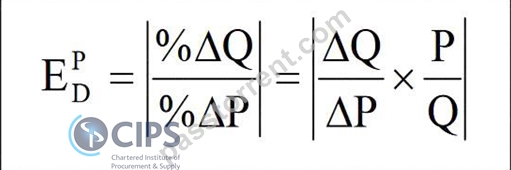
Table Description automatically generated with medium confidence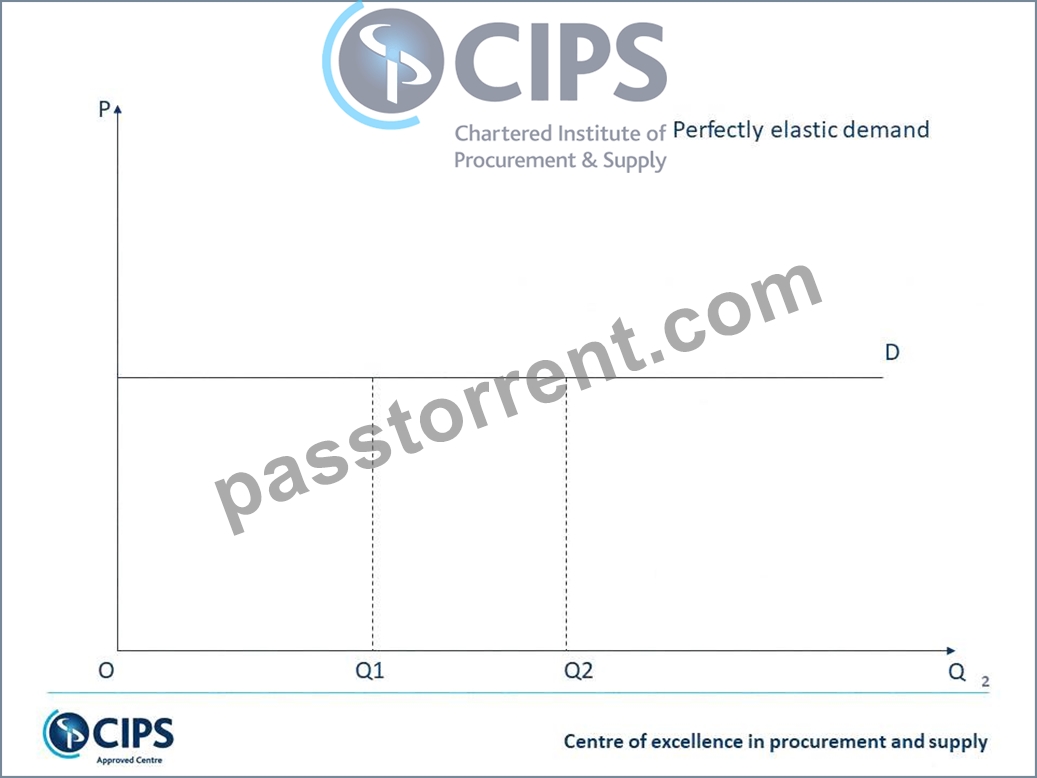
Table Description automatically generated with low confidence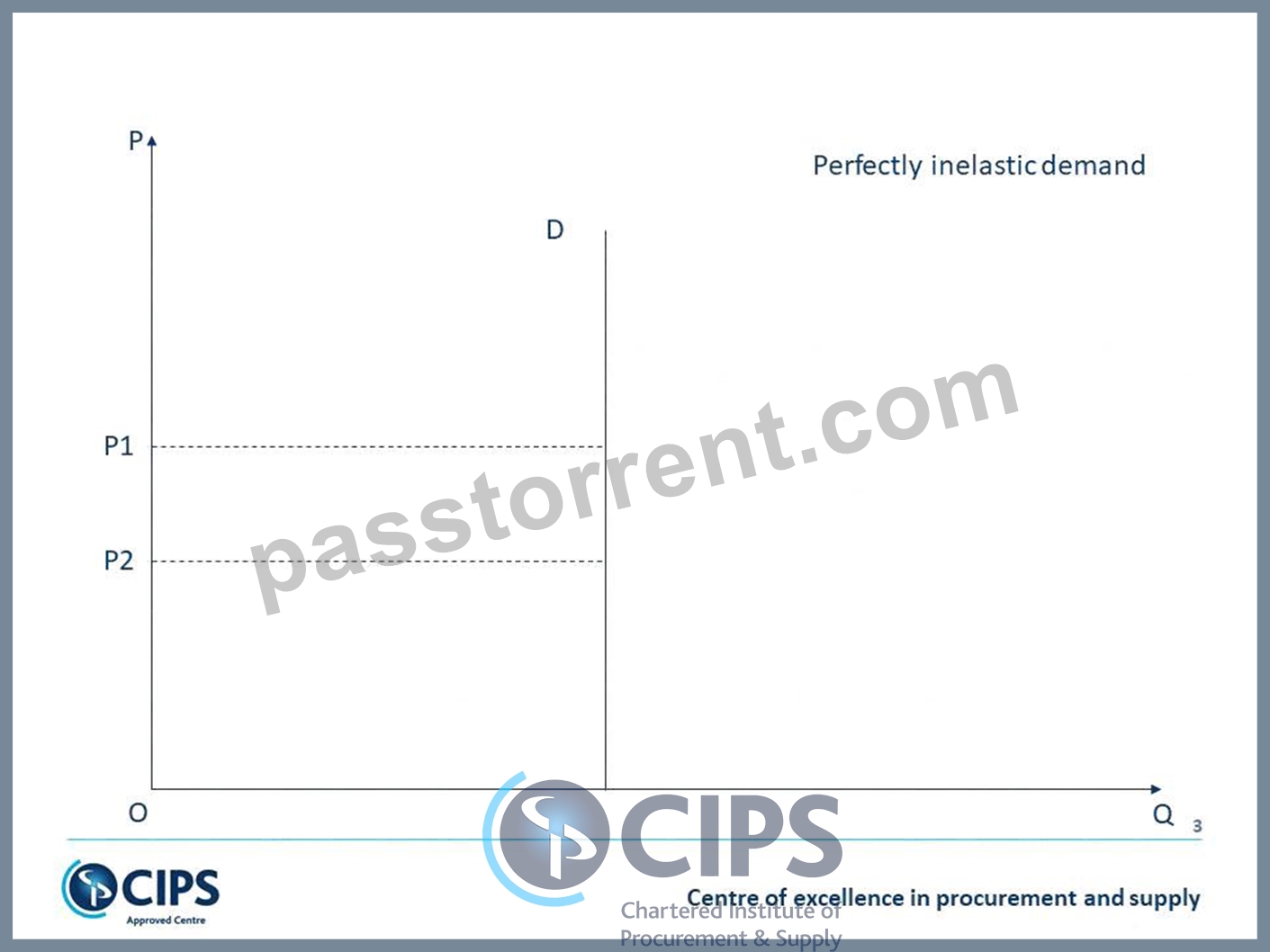
LO 2, AC 2.2
NEW QUESTION # 91
......
New L4M5 Dumps - Real CIPS Exam Questions: https://www.passtorrent.com/L4M5-latest-torrent.html
Dependable L4M5 Exam Dumps to Become CIPS Certified: https://drive.google.com/open?id=1wSCinK0vLUvmLMU9ZqPm7RA8vA8c8yL7