


[2024] Get Top-Rated Amazon MLS-C01 Exam Dumps Now
Passing Key To Getting MLS-C01 Certified Exam Engine PDF
The AWS-Certified-Machine-Learning-Specialty certification is an essential qualification for professionals who want to work with machine learning services on the AWS platform. AWS Certified Machine Learning - Specialty certification validates the skills and knowledge of professionals and is recognized globally by employers. Candidates who are interested in taking the exam should prepare by taking online courses, reading books, and practicing with sample questions.
Amazon MLS-C01 certification is designed to validate an individual's expertise in machine learning on AWS platform. AWS Certified Machine Learning - Specialty certification is highly valued in the industry and is recognized globally. MLS-C01 exam covers a wide range of topics, including data preparation, feature engineering, model training, evaluation and deployment, and machine learning implementation and operations. AWS Certified Machine Learning - Specialty certification is ideal for individuals looking to build a career in machine learning on AWS and is highly valued by organizations that are looking to hire ML professionals.
NEW QUESTION # 91
A library is developing an automatic book-borrowing system that uses Amazon Rekognition. Images of library members' faces are stored in an Amazon S3 bucket. When members borrow books, the Amazon Rekognition CompareFaces API operation compares real faces against the stored faces in Amazon S3.
The library needs to improve security by making sure that images are encrypted at rest. Also, when the images are used with Amazon Rekognition. they need to be encrypted in transit. The library also must ensure that the images are not used to improve Amazon Rekognition as a service.
How should a machine learning specialist architect the solution to satisfy these requirements?
- A. Enable client-side encryption on the S3 bucket. Set up a VPN connection and only call the Amazon Rekognition API operations through the VPN.
- B. Switch to using an Amazon Rekognition collection to store the images. Use the IndexFaces and SearchFacesByImage API operations instead of the CompareFaces API operation.
- C. Enable server-side encryption on the S3 bucket. Submit an AWS Support ticket to opt out of allowing images to be used for improving the service, and follow the process provided by AWS Support.
- D. Switch to using the AWS GovCloud (US) Region for Amazon S3 to store images and for Amazon Rekognition to compare faces. Set up a VPN connection and only call the Amazon Rekognition API operations through the VPN.
Answer: B
NEW QUESTION # 92
A Machine Learning Specialist is building a model that will perform time series forecasting using Amazon SageMaker. The Specialist has finished training the model and is now planning to perform load testing on the endpoint so they can configure Auto Scaling for the model variant.
Which approach will allow the Specialist to review the latency, memory utilization, and CPU utilization during the load test?
- A. Generate an Amazon CloudWatch dashboard to create a single view for the latency, memory utilization, and CPU utilization metrics that are outputted by Amazon SageMaker.
- B. Send Amazon CloudWatch Logs that were generated by Amazon SageMaker to Amazon ES and use Kibana to query and visualize the log data.
- C. Review SageMaker logs that have been written to Amazon S3 by leveraging Amazon Athena and Amazon QuickSight to visualize logs as they are being produced.
- D. Build custom Amazon CloudWatch Logs and then leverage Amazon ES and Kibana to query and visualize the log data as it is generated by Amazon SageMaker.
Answer: A
Explanation:
Explanation/Reference: https://docs.aws.amazon.com/sagemaker/latest/dg/monitoring-cloudwatch.html
NEW QUESTION # 93
A data scientist needs to identify fraudulent user accounts for a company's ecommerce platform. The company wants the ability to determine if a newly created account is associated with a previously known fraudulent user. The data scientist is using AWS Glue to cleanse the company's application logs during ingestion.
Which strategy will allow the data scientist to identify fraudulent accounts?
- A. Create an AWS Glue crawler to infer duplicate accounts in the source data.
- B. Create a FindMatches machine learning transform in AWS Glue.
- C. Execute the built-in FindDuplicates Amazon Athena query.
- D. Search for duplicate accounts in the AWS Glue Data Catalog.
Answer: B
NEW QUESTION # 94
A Machine Learning Specialist wants to bring a custom algorithm to Amazon SageMaker. The Specialist implements the algorithm in a Docker container supported by Amazon SageMaker.
How should the Specialist package the Docker container so that Amazon SageMaker can launch the training correctly?
- A. Copy the training program to directory /opt/ml/train
- B. Use CMD config in the Dockerfile to add the training program as a CMD of the image
- C. Modify the bash_profile file in the container and add a bash command to start the training program
- D. Configure the training program as an ENTRYPOINT named train
Answer: B
NEW QUESTION # 95
An online reseller has a large, multi-column dataset with one column missing 30% of its data. A Machine Learning Specialist believes that certain columns in the dataset could be used to reconstruct the missing data.
Which reconstruction approach should the Specialist use to preserve the integrity of the dataset?
- A. Mean substitution
- B. Listwise deletion
- C. Multiple imputation
- D. Last observation carried forward
Answer: C
Explanation:
https://worldwidescience.org/topicpages/i/imputing+missing+values.html
NEW QUESTION # 96
An employee found a video clip with audio on a company's social media feed. The language used in the video is Spanish. English is the employee's first language, and they do not understand Spanish. The employee wants to do a sentiment analysis.
What combination of services is the MOST efficient to accomplish the task?
- A. Amazon Transcribe, Amazon Translate, and Amazon Comprehend
- B. Amazon Transcribe, Amazon Translate, and Amazon SageMaker Neural Topic Model (NTM)
- C. Amazon Transcribe, Amazon Comprehend, and Amazon SageMaker seq2seq
- D. Amazon Transcribe, Amazon Translate and Amazon SageMaker BlazingText
Answer: B
NEW QUESTION # 97
For the given confusion matrix, what is the recall and precision of the model?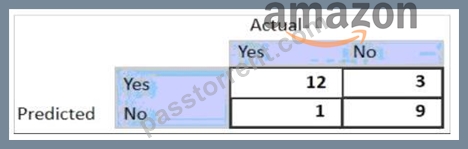
- A. Recall = 0.92 Precision = 0.84
- B. Recall = 0.8 Precision = 0.92
- C. Recall = 0.92 Precision = 0.8
- D. Recall = 0.84 Precision = 0.8
Answer: A
NEW QUESTION # 98
A retail company intends to use machine learning to categorize new products A labeled dataset of current products was provided to the Data Science team The dataset includes 1 200 products The labeled dataset has 15 features for each product such as title dimensions, weight, and price Each product is labeled as belonging to one of six categories such as books, games, electronics, and movies.
Which model should be used for categorizing new products using the provided dataset for training?
- A. An XGBoost model where the objective parameter is set to multi: softmax
- B. A DeepAR forecasting model based on a recurrent neural network (RNN)
- C. A deep convolutional neural network (CNN) with a softmax activation function for the last layer
- D. A regression forest where the number of trees is set equal to the number of product categories
Answer: A
NEW QUESTION # 99
A Data Scientist is developing a machine learning model to classify whether a financial transaction is fraudulent. The labeled data available for training consists of 100,000 non- fraudulent observations and 1,000 fraudulent observations.
The Data Scientist applies the XGBoost algorithm to the data, resulting in the following confusion matrix when the trained model is applied to a previously unseen validation dataset. The accuracy of the model is 99.1%, but the Data Scientist has been asked to reduce the number of false negatives.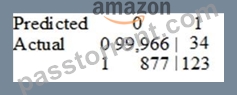
Which combination of steps should the Data Scientist take to reduce the number of false positive predictions by the model? (Choose two.)
- A. Change the XGBoost eval_metric parameter to optimize based on rmse instead of error.
- B. Change the XGBoost eval_metric parameter to optimize based on AUC instead of error.
- C. Increase the XGBoost max_depth parameter because the model is currently underfitting the data.
- D. Decrease the XGBoost max_depth parameter because the model is currently overfitting the data.
- E. Increase the XGBoost scale_pos_weight parameter to adjust the balance of positive and negative weights.
Answer: B,E
NEW QUESTION # 100
A Machine Learning Specialist is using an Amazon SageMaker notebook instance in a private subnet of a corporate VPC. The ML Specialist has important data stored on the Amazon SageMaker notebook instance's Amazon EBS volume, and needs to take a snapshot of that EBS volume. However, the ML Specialist cannot find the Amazon SageMaker notebook instance's EBS volume or Amazon EC2 instance within the VPC.
Why is the ML Specialist not seeing the instance visible in the VPC?
- A. Amazon SageMaker notebook instances are based on EC2 instances running within AWS service accounts.
- B. Amazon SageMaker notebook instances are based on the EC2 instances within the customer account, but they run outside of VPCs.
- C. Amazon SageMaker notebook instances are based on AWS ECS instances running within AWS service accounts.
- D. Amazon SageMaker notebook instances are based on the Amazon ECS service within customer accounts.
Answer: A
Explanation:
Explanation/Reference: https://docs.aws.amazon.com/sagemaker/latest/dg/gs-setup-working-env.html
NEW QUESTION # 101
A retail company is using Amazon Personalize to provide personalized product recommendations for its customers during a marketing campaign. The company sees a significant increase in sales of recommended items to existing customers immediately after deploying a new solution version, but these sales decrease a short time after deployment. Only historical data from before the marketing campaign is available for training.
How should a data scientist adjust the solution?
- A. Use the event tracker in Amazon Personalize to include real-time user interactions.
- B. Add user metadata and use the HRNN-Metadata recipe in Amazon Personalize.
- C. Implement a new solution using the built-in factorization machines (FM) algorithm in Amazon SageMaker.
- D. Add event type and event value fields to the interactions dataset in Amazon Personalize.
Answer: D
NEW QUESTION # 102
A company has video feeds and images of a subway train station. The company wants to create a deep learning model that will alert the station manager if any passenger crosses the yellow safety line when there is no train in the station. The alert will be based on the video feeds. The company wants the model to detect the yellow line, the passengers who cross the yellow line, and the trains in the video feeds. This task requires labeling. The video data must remain confidential.
A data scientist creates a bounding box to label the sample data and uses an object detection model. However, the object detection model cannot clearly demarcate the yellow line, the passengers who cross the yellow line, and the trains.
Which labeling approach will help the company improve this model?
- A. Use Amazon Rekognition Custom Labels to label the dataset and create a custom Amazon Rekognition object detection model. Create a private workforce. Use Amazon Augmented AI (Amazon A2I) to review the low-confidence predictions and retrain the custom Amazon Rekognition model.
- B. Use an Amazon SageMaker Ground Truth semantic segmentation labeling task. Use a private workforce as the labeling workforce.
- C. Use an Amazon SageMaker Ground Truth object detection labeling task. Use Amazon Mechanical Turk as the labeling workforce.
- D. Use Amazon Rekognition Custom Labels to label the dataset and create a custom Amazon Rekognition object detection model. Create a workforce with a third-party AWS Marketplace vendor. Use Amazon Augmented AI (Amazon A2I) to review the low-confidence predictions and retrain the custom Amazon Rekognition model.
Answer: C
NEW QUESTION # 103
A real estate company wants to create a machine learning model for predicting housing prices based on a historical dataset. The dataset contains 32 features.
Which model will meet the business requirement?
- A. Principal component analysis (PCA)
- B. Logistic regression
- C. K-means
- D. Linear regression
Answer: D
NEW QUESTION # 104
A Machine Learning Specialist works for a credit card processing company and needs to predict which transactions may be fraudulent in near-real time. Specifically, the Specialist must train a model that returns the probability that a given transaction may be fraudulent How should the Specialist frame this business problem'?
- A. Binary classification
- B. Multi-category classification
- C. Regression classification
- D. Streaming classification
Answer: D
NEW QUESTION # 105
A retail chain has been ingesting purchasing records from its network of 20,000 stores to Amazon S3 using Amazon Kinesis Data Firehose. To support training an improved machine learning model, training records will require new but simple transformations, and some attributes will be combined. The model needs to be retrained daily.
Given the large number of stores and the legacy data ingestion, which change will require the LEAST amount of development effort?
- A. Require that the stores to switch to capturing their data locally on AWS Storage Gateway for loading into Amazon S3, then use AWS Glue to do the transformation.
- B. Insert an Amazon Kinesis Data Analytics stream downstream of the Kinesis Data Firehose stream that transforms raw record attributes into simple transformed values using SQL.
- C. Deploy an Amazon EMR cluster running Apache Spark with the transformation logic, and have the cluster run each day on the accumulating records in Amazon S3, outputting new/transformed records to Amazon S3.
- D. Spin up a fleet of Amazon EC2 instances with the transformation logic, have them transform the data records accumulating on Amazon S3, and output the transformed records to Amazon S3.
Answer: B
NEW QUESTION # 106
A Machine Learning Specialist deployed a model that provides product recommendations on a company's website. Initially, the model was performing very well and resulted in customers buying more products on average. However, within the past few months, the Specialist has noticed that the effect of product recommendations has diminished and customers are starting to return to their original habits of spending less.
The Specialist is unsure of what happened, as the model has not changed from its initial deployment over a year ago.
Which method should the Specialist try to improve model performance?
- A. The model needs to be completely re-engineered because it is unable to handle product inventory changes.
- B. The model should be periodically retrained using the original training data plus new data as product inventory changes.
- C. The model should be periodically retrained from scratch using the original data while adding a regularization term to handle product inventory changes
- D. The model's hyperparameters should be periodically updated to prevent drift.
Answer: B
NEW QUESTION # 107
A retail chain has been ingesting purchasing records from its network of 20,000 stores to Amazon S3 using Amazon Kinesis Data Firehose. To support training an improved machine learning model, training records will require new but simple transformations, and some attributes will be combined. The model needs to be retrained daily.
Given the large number of stores and the legacy data ingestion, which change will require the LEAST amount of development effort?
- A. Require that the stores to switch to capturing their data locally on AWS Storage Gateway for loading into Amazon S3, then use AWS Glue to do the transformation.
- B. Insert an Amazon Kinesis Data Analytics stream downstream of the Kinesis Data Firehose stream that transforms raw record attributes into simple transformed values using SQL.
- C. Deploy an Amazon EMR cluster running Apache Spark with the transformation logic, and have the cluster run each day on the accumulating records in Amazon S3, outputting new/transformed records to Amazon S3.
- D. Spin up a fleet of Amazon EC2 instances with the transformation logic, have them transform the data records accumulating on Amazon S3, and output the transformed records to Amazon S3.
Answer: B
NEW QUESTION # 108
A Machine Learning Specialist is developing a custom video recommendation model for an application. The dataset used to train this model is very large with millions of data points and is hosted in an Amazon S3 bucket. The Specialist wants to avoid loading all of this data onto an Amazon SageMaker notebook instance because it would take hours to move and will exceed the attached 5 GB Amazon EBS volume on the notebook instance.
Which approach allows the Specialist to use all the data to train the model?
- A. Use AWS Glue to train a model using a small subset of the data to confirm that the data will be compatible with Amazon SageMaker. Initiate a SageMaker training job using the full dataset from the S3 bucket using Pipe input mode.
- B. Launch an Amazon EC2 instance with an AWS Deep Learning AMI and attach the S3 bucket to the instance. Train on a small amount of the data to verify the training code and hyperparameters. Go back to Amazon SageMaker and train using the full dataset
- C. Load a smaller subset of the data into the SageMaker notebook and tram locally. Confirm that the training code is executing and the model parameters seem reasonable. Launch an Amazon EC2 instance with an AWS Deep Learning AMI and attach the S3 bucket to train the full dataset.
- D. Load a smaller subset of the data into the SageMaker notebook and train locally. Confirm that the training code is executing and the model parameters seem reasonable. Initiate a SageMaker training job using the full dataset from the S3 bucket using Pipe input mode.
Answer: C
NEW QUESTION # 109
Example Corp has an annual sale event from October to December. The company has sequential sales data from the past 15 years and wants to use Amazon ML to predict the sales for this year's upcoming event. Which method should Example Corp use to split the data into a training dataset and evaluation dataset?
- A. Have Amazon ML split the data randomly.
- B. Pre-split the data before uploading to Amazon S3
- C. Have Amazon ML split the data sequentially.
- D. Perform custom cross-validation on the data
Answer: C
NEW QUESTION # 110
A Data Science team is designing a dataset repository where it will store a large amount of training data commonly used in its machine learning models. As Data Scientists may create an arbitrary number of new datasets every day, the solution has to scale automatically and be cost-effective. Also, it must be possible to explore the data using SQL.
Which storage scheme is MOST adapted to this scenario?
- A. Store datasets as tables in a multi-node Amazon Redshift cluster.
- B. Store datasets as files in Amazon S3.
- C. Store datasets as global tables in Amazon DynamoDB.
- D. Store datasets as files in an Amazon EBS volume attached to an Amazon EC2 instance.
Answer: B
NEW QUESTION # 111
A Mobile Network Operator is building an analytics platform to analyze and optimize a company's operations using Amazon Athena and Amazon S3 The source systems send data in CSV format in real lime The Data Engineering team wants to transform the data to the Apache Parquet format before storing it on Amazon S3 Which solution takes the LEAST effort to implement?
- A. Ingest .CSV data from Amazon Kinesis Data Streams and use Amazon Glue to convert data into Parquet.
- B. Ingest .CSV data using Apache Kafka Streams on Amazon EC2 instances and use Kafka Connect S3 to serialize data as Parquet
- C. Ingest .CSV data using Apache Spark Structured Streaming in an Amazon EMR cluster and use Apache Spark to convert data into Parquet.
- D. Ingest .CSV data from Amazon Kinesis Data Streams and use Amazon Kinesis Data Firehose to convert data into Parquet.
Answer: A
Explanation:
https://medium.com/searce/convert-csv-json-files-to-apache-parquet-using-aws-glue-a760d177b45f
https://github.com/ecloudvalley/Building-a-Data-Lake-with-AWS-Glue-and-Amazon-S3
NEW QUESTION # 112
A Machine Learning Specialist is given a structured dataset on the shopping habits of a company's customer base. The dataset contains thousands of columns of data and hundreds of numerical columns for each customer. The Specialist wants to identify whether there are natural groupings for these columns across all customers and visualize the results as quickly as possible.
What approach should the Specialist take to accomplish these tasks?
- A. Embed the numerical features using the t-distributed stochastic neighbor embedding (t-SNE) algorithm and create a line graph.
- B. Embed the numerical features using the t-distributed stochastic neighbor embedding (t-SNE) algorithm and create a scatter plot.
- C. Run k-means using the Euclidean distance measure for different values of k and create box plots for each numerical column within each cluster.
- D. Run k-means using the Euclidean distance measure for different values of k and create an elbow plot.
Answer: D
NEW QUESTION # 113
A Data Scientist needs to migrate an existing on-premises ETL process to the cloud. The current process runs at regular time intervals and uses PySpark to combine and format multiple large data sources into a single consolidated output for downstream processing.
The Data Scientist has been given the following requirements to the cloud solution:
* Combine multiple data sources.
* Reuse existing PySpark logic.
* Run the solution on the existing schedule.
* Minimize the number of servers that will need to be managed.
Which architecture should the Data Scientist use to build this solution?
- A. Write the raw data to Amazon S3. Schedule an AWS Lambda function to run on the existing schedule and process the input data from Amazon S3. Write the Lambda logic in Python and implement the existing PySpark logic to perform the ETL process. Have the Lambda function output the results to a "processed" location in Amazon S3 that is accessible for downstream use.
- B. Use Amazon Kinesis Data Analytics to stream the input data and perform real-time SQL queries against the stream to carry out the required transformations within the stream. Deliver the output results to a
"processed" location in Amazon S3 that is accessible for downstream use. - C. Write the raw data to Amazon S3. Schedule an AWS Lambda function to submit a Spark step to a persistent Amazon EMR cluster based on the existing schedule. Use the existing PySpark logic to run the ETL job on the EMR cluster. Output the results to a "processed" location in Amazon S3 that is accessible for downstream use.
- D. Write the raw data to Amazon S3. Create an AWS Glue ETL job to perform the ETL processing against the input data. Write the ETL job in PySpark to leverage the existing logic. Create a new AWS Glue trigger to trigger the ETL job based on the existing schedule. Configure the output target of the ETL job to write to a
"processed" location in Amazon S3 that is accessible for downstream use.
Answer: B
NEW QUESTION # 114
A city wants to monitor its air quality to address the consequences of air pollution. A Machine Learning Specialist needs to forecast the air quality in parts per million of contaminates for the next 2 days in the city. As this is a prototype, only daily data from the last year is available.
Which model is MOST likely to provide the best results in Amazon SageMaker?
- A. Use the Amazon SageMaker k-Nearest-Neighbors (kNN) algorithm on the single time series consisting of the full year of data with a predictor_typeof regressor.
- B. Use the Amazon SageMaker Linear Learner algorithm on the single time series consisting of the full year of data with a predictor_typeof classifier.
- C. Use Amazon SageMaker Random Cut Forest (RCF) on the single time series consisting of the full year of data.
- D. Use the Amazon SageMaker Linear Learner algorithm on the single time series consisting of the full year of data with a predictor_typeof regressor.
Answer: D
Explanation:
Explanation/Reference: https://aws.amazon.com/blogs/machine-learning/build-a-model-to-predict-the-impact-of-weather- on-urban-air-quality-using-amazon-sagemaker/?ref=Welcome.AI
NEW QUESTION # 115
A Machine Learning Engineer is preparing a data frame for a supervised learning task with the Amazon SageMaker Linear Learner algorithm. The ML Engineer notices the target label classes are highly imbalanced and multiple feature columns contain missing values. The proportion of missing values across the entire data frame is less than 5%.
What should the ML Engineer do to minimize bias due to missing values?
- A. Replace each missing value by the mean or median across non-missing values in same row.
- B. Delete observations that contain missing values because these represent less than 5% of the data.
- C. For each feature, approximate the missing values using supervised learning based on other features.
- D. Replace each missing value by the mean or median across non-missing values in the same column.
Answer: C
Explanation:
Use supervised learning to predict missing values based on the values of other features. Different supervised learning approaches might have different performances, but any properly implemented supervised learning approach should provide the same or better approximation than mean or median approximation, as proposed in responses A and C.
Supervised learning applied to the imputation of missing values is an active field of research.
NEW QUESTION # 116
......
The Amazon MLS-C01 exam is designed to test an individual's knowledge and proficiency in a number of key areas, including data preparation, feature engineering, model selection, and optimization. Candidates are also expected to have a deep understanding of the AWS services and tools that are used for machine learning, including Amazon SageMaker, Amazon Rekognition, and Amazon Comprehend.
MLS-C01 exam questions for practice in 2024 Updated 210 Questions: https://www.passtorrent.com/MLS-C01-latest-torrent.html
MLS-C01 Exam Dumps Pass with Updated Tests Dumps: https://drive.google.com/open?id=1WKvAggVLvklCRmXfSGbeFnuwH6l57TQl