


Updated Oct 03, 2025 Verified Pass JN0-105 Exam in First Attempt Guaranteed
Free JN0-105 Sample Questions and 100% Cover Real Exam Questions (Updated 102 Questions)
Juniper JN0-105 Exam Syllabus Topics:
| Topic | Details |
|---|---|
| Topic 1 |
|
| Topic 2 |
|
| Topic 3 |
|
| Topic 4 |
|
| Topic 5 |
|
| Topic 6 |
|
NEW QUESTION # 34
Click the Exhibit button.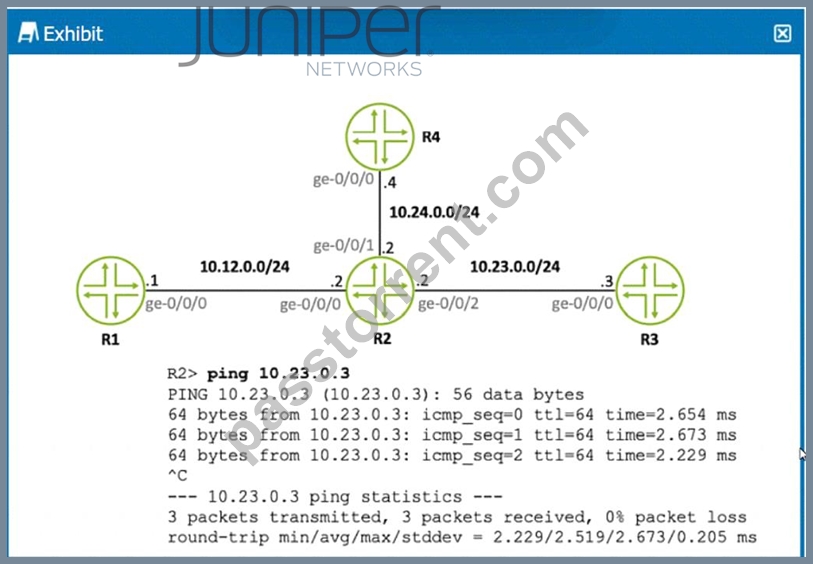
Referring to the exhibit, what is the source IP address of the ping that was executed?
- A. 10.12.0.2
- B. 10.24.0.4
- C. 10.23.0.2
- D. 10.23.0.3
Answer: C
Explanation:
The exhibit shows a ping test being executed from router R2 to the IP address 10.23.0.3. Since the ping command is issued on R2 and we see successful replies from 10.23.0.3, it means the source of the ping must be an interface on R2. Given the network diagram and the IP address scheme, the source IP address of the ping is on the interface ge-0/0/2 of R2, which is in the subnet 10.23.0.0/24. The only logical IP address for R2's interface in this subnet, based on standard networking practices and the given options, would be 10.23.0.2. The other addresses provided in the options belong to different subnets or are the destination of the ping itself.
NEW QUESTION # 35
What is the primary system log file that is present in the default configuration of a Junos device?
- A. kmd
- B. jsrpd
- C. messages
- D. vrrp
Answer: C
Explanation:
In the default configuration of a Junos device, the primary system log file is "messages" (B). This log file contains a wide range of system messages, including operational status changes, system errors, and other critical information, making it a key resource for troubleshooting and monitoring the system's health.
NEW QUESTION # 36
What does the user@router> clear log ospf-trace command accomplish?
- A. Trace parameters are removed from the OSPF protocol configuration.
- B. The ospf-trace file is deleted.
- C. Data in the ospf-trace file is removed and logging continues.
- D. Logging data into ospf-trace is stopped.
Answer: C
Explanation:
The clear log ospf-trace command on a Juniper Networks router is used specifically to manage the contents of the log file named ospf-trace. Executing this command clears or deletes the existing data within the ospf-trace log file but does not stop the logging process. The router continues to log new OSPF-related events and data into this file after the command is executed. This functionality is crucial for troubleshooting and monitoring the OSPF (Open Shortest Path First) protocol's operation by allowing network administrators to remove old or irrelevant log data while continuously capturing new events without interruption.
NEW QUESTION # 37
When considering routing tables and forwarding tables, which two statements are correct? (Choose two.)
- A. The routing table stores all routes and prefixes from all protocols.
- B. The routing table is used by the RE to select the best route.
- C. The forwarding table stores all routes and prefixes from all protocols.
- D. The forwarding table is used by the RE to select the best route.
Answer: A,B
Explanation:
The routing table and forwarding table play distinct roles in a Junos OS device. The correct answers are A and D.
The routing table (A) is used by the Routing Engine (RE) to select the best route among all the learned routes, while the routing table (D) stores all routes and prefixes learned from all routing protocols. The forwarding table, in contrast, contains only the active routes chosen by the RE and is used by the Packet Forwarding Engine for actual packet forwarding.
NEW QUESTION # 38
Exhibit
user@router> show route 192.168.100.2
inet.O: 15 destinations, 17 routes (15 active, 0 holddown, 0 hidden) Limit/Threshold: 1048576/1048576 destinations
+ = Active Route, - = Last Active, * = Both 192.168.100.2/32*[OSPF/IO] 00:14:29, metric 1
> to 172.16.1.6 via ge-0/0/1.0 [BGP/170] 00:06:49, localpref 100
AS path: 65102 I, validation-state: unverified > to 172.16.1.6 via ge-0/0/1.0 Referring to the exhibit, which statement is correct?
- A. / Traffic is load-balanced across two routes.
- B. The OSPF path is the only active route.
- C. The BGP path is the only active route.
- D. The BGP route is preferred over the OSPF route.
Answer: B
Explanation:
Referring to the exhibit, the presence of the "+" symbol next to the OSPF route for 192.168.100.2/32 indicates that this is the active route being used to forward traffic. The BGP route, although present, does not have the
"+" symbol, indicating it is not the active route. In Junos OS, the routing table displays the active route with a
"+" symbol, and the fact that the OSPF route has this symbol means it is the preferred path based on the routing protocol'sdecision process, which takes into account factors such as route preference (administrative distance) and metrics.
NEW QUESTION # 39
Which prompt indicates that you are using configuration mode?
- A. $
- B. %
- C. >
- D. #
Answer: D
Explanation:
In Junos OS, the # prompt indicates that you are in configuration mode. This mode is used for making changes to the configuration of the device.
NEW QUESTION # 40
Which two statements are true about the candidate configuration? (Choose two.)
- A. Candidate configuration changes are automatically applied.
- B. You can deploy multiple changes at the same time.
- C. Multiple users cannot modify the same candidate configuration.
- D. You can discard changes before committing them.
Answer: B,D
Explanation:
The candidate configuration in Junos OS is a temporary configuration that allows network administrators to make and stage multiple configuration changes before applying them to the device. This approach enables the deployment of multiple changes in a single operation, ensuring that all configurations work together as intended before making them active. Additionally, the candidate configuration can be discarded if the administrator decides not to apply the staged changes, allowing for a "trial and error" approach without affecting the currently active configuration. This feature provides flexibility and reduces the risk of disruptive changes to the network.
NEW QUESTION # 41
Which statement is correct when multiple users are configuring a Junos device using the configure private command?
- A. A commit will not succeed until there is only a single user in configuration mode.
- B. Each user gets their own candidate configuration.
- C. Each user shares the same candidate configuration.
- D. A commit by any user will commit changes made by all active users.
Answer: B
Explanation:
When multiple users are configuring a Junos device using the "configure private" command, each user gets their own candidate configuration (C). This allows for isolated configuration sessions, where changes made by one user do not impact or interfere with the changes made by another user in their private session.
NEW QUESTION # 42
Click the Exhibit button.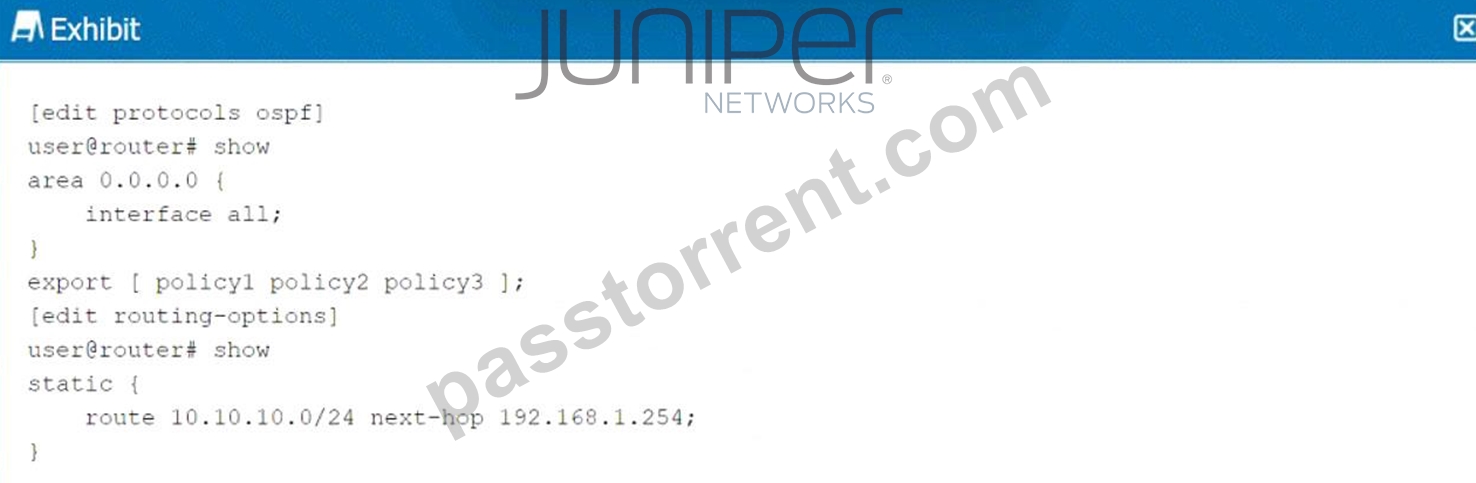
Referring to the exhibit, OSPF has three export policies that match different static route prefixes. The
10.10.10.0/24 static route does not match any terms in the policyl routing policy.
What happens next in this scenario?
- A. Thestaticrouteisrejected by the policyl routing policy.
- B. Thestaticrouteisrejected by the default routing policy.
- C. Thestaticrouteisevaluated by the poiicy2 routing policy.
- D. Thestaticrouteisevaluated by the poiicy3 routing policy.
Answer: C
Explanation:
In Junos, when multiple policies are applied to a routing protocol for route export, the routes are evaluated in the order in which the policies are listed. In the exhibit, the OSPF configuration has three export policies listed: policy1, policy2, and policy3. The static route 10.10.10.0/24 does not match any terms in policy1; therefore, it is not rejected by policy1 but is instead passed on to the next policy in the sequence, which is policy2.
If the static route matches a term in policy2 that permits the route, it will be exported into OSPF. If it does not match in policy2, it will then be evaluated by policy3. If there is no match in policy3 as well, and assuming there are no more policies listed, the route would then be subject to the default routing policy behavior, which typically rejects the route unless an explicit accept statement is present in the policies.
NEW QUESTION # 43
Click the Exhibit button.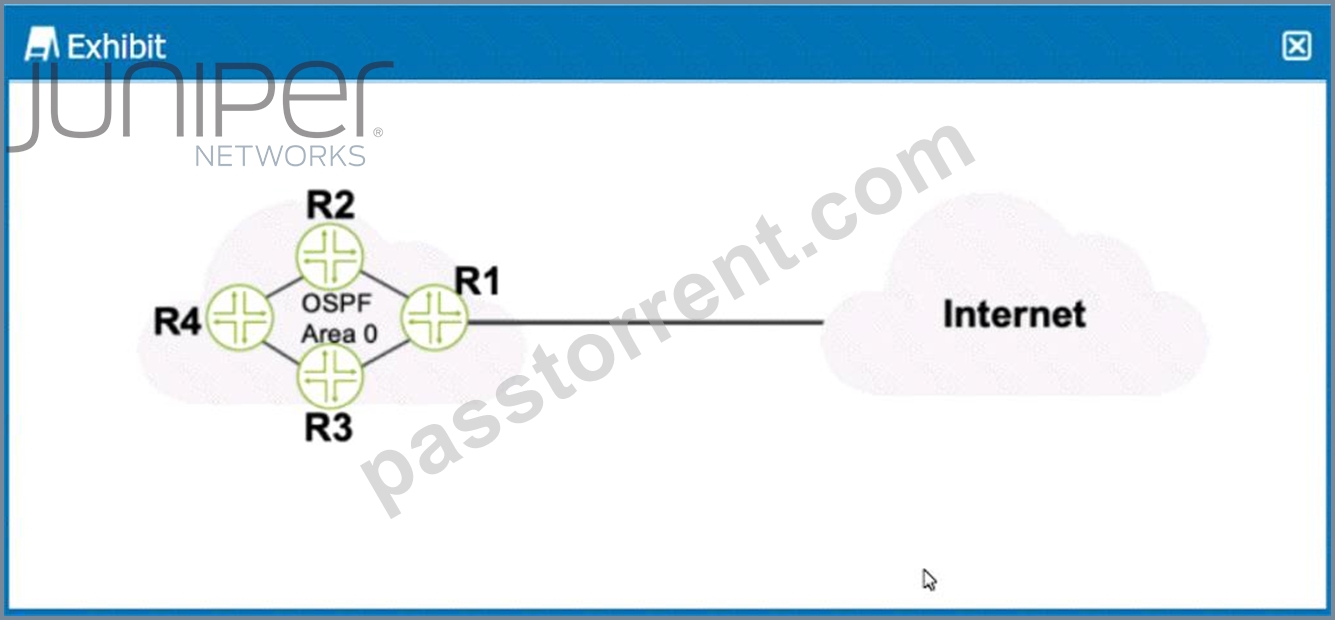
Referring to the exhibit, what should be configured on R1 to advertise a default static route into OSPF?
- A. a firewall filter
- B. a routing policy
- C. a loopback interface
- D. a management interface
Answer: B
Explanation:
To advertise a default static route into OSPF on router R1, a routing policy should be configured. This policy would typically include a statement to match the default route (0.0.0.0/0) and then apply an action to set the route as an OSPF external type, which would then be redistributed into the OSPF domain. The routing policy is a set of conditions and actions that determine how routes are imported into or exported from the routing table and how routes are shared between routing instances or routing protocols. After defining the policy, it must be applied to OSPF under the export section of the OSPF configuration on R1. This process will allow R1 to announce the default route to other OSPF routers in the network, which then can use it as a gateway of last resort to reach the Internet or other networks not explicitly known to the OSPF domain.
NEW QUESTION # 44
Which advantage is provided by multiple software processes running in the Junos OS?
- A. Each process allocates a fixed amount of CPU resources.
- B. Each process runs in a protected memory space.
- C. Each process is started manually to ensure system stability.
- D. Each process dependency can be mapped independently.
Answer: B
Explanation:
In the Junos OS, multiple software processes run independently in their own protected memory spaces. This design ensures that if one process crashes or encounters an issue, it does not affect the other processes running on the system. This architecture enhances the stability and reliability of the network device, as each process operates independently and securely.
NEW QUESTION # 45
Which Junos OS component is responsible for maintaining the forwarding table?
- A. Packet Forwarding Engine
- B. Routing Engine
- C. chassis control daemon
- D. management daemon
Answer: A
Explanation:
The Packet Forwarding Engine (PFE) in Junos OS is responsible for maintaining the forwarding table. The PFE processes incoming packets, performs route lookups in the forwarding table, and forwards packets based on this information, offloading these tasks from the Routing Engine to ensure efficient packet forwarding.
NEW QUESTION # 46
You are asked to view the real-time usage statistics for the busiest interfaces on a device running Junos OS.
Which command will achieve this task?
- A. monitor traffic
- B. monitor traffic absolute-sequence
- C. monitor interface traffic
- D. show interfaces extensive
Answer: C
Explanation:
To view real-time usage statistics for the busiest interfaces on a device running Junos OS, the correct command is B, "monitor interface traffic." This command provides a dynamic, real-time view of the traffic flowing through the interfaces, allowing administrators to quickly identify and monitor the busiest interfaces on the device.
NEW QUESTION # 47
Your network infrastructure transports data, voice, and video traffic. Users are complaining that voice and video calls are not performing to their expectations.
In this scenario, which technology would you implement to improve voice and video performance on your network?
- A. CoS
- B. STP
- C. IPv6
- D. NAT
Answer: A
Explanation:
In a network that carries diverse types of traffic like data, voice, and video, ensuring the performance of latency-sensitive applications such as voice and video calls is crucial. Class of Service (CoS) is a technology designed to prioritize network traffic, ensuring that critical applications like voice and video receive the necessary bandwidth and minimal latency. CoS mechanisms can include traffic classification, traffic policing, queue management, and scheduling. By implementing CoS, network administrators can assign higher priority to voice and video traffic, thus improving their performance across the network and addressing the users' complaints about call quality.
NEW QUESTION # 48
Which criteria does the Junos OS use to select an active route when two entries exist in the routing table?
- A. the most recently learned dynamic route
- B. the route with the lowest preference number
- C. the route with the highest metric
- D. the route with the highest preference number
Answer: B
Explanation:
In Junos OS, when two entries for the same destination exist in the routing table, the route with the lowest preference number is selected as the active route. This preference number, also known as the route preference or administrative distance, is used to prioritize routes received from different routing protocols.
NEW QUESTION # 49
Which type of device uses the destination IP address to forward packets?
- A. repeater
- B. Layer 3 router
- C. Layer 2 switch
- D. hub
Answer: B
Explanation:
A Layer 3 router uses the destination IP address to forward packets. The correct answer is A. Routers operate at Layer 3 of the OSI model and make forwarding decisions based on IP addresses. They are responsible for routing packets across different networks by examining the destination IP address contained in the packet's header.
NEW QUESTION # 50
......
Download Real Juniper JN0-105 Exam Dumps Test Engine Exam Questions: https://www.passtorrent.com/JN0-105-latest-torrent.html
Verified JN0-105 Dumps Q&As - JN0-105 Test Engine with Correct Answers: https://drive.google.com/open?id=1gEt9fK2cnNZWKL1HYcIEq1_0-QLq4Gpq