


Best ISQI CTFL_Syll_4.0 Exam Practice Material Updated on Feb 06, 2026
New CTFL_Syll_4.0 Actual Exam Dumps, ISQI Practice Test
NEW QUESTION # 46
Which ONE of the following options BEST describes black-box test techniques?
- A. Black-box testing techniques are based on analyzing the test object's specified and implied behavior without knowledge of its internal data structure.
- B. In black-box testing techniques, test cases are created based on the software's implementation.
- C. Black-box testing techniques involve analyzing the specified behavior of the test object without knowledge of its internal structure.
- D. Black-box testing techniques are based on experience with the test object without knowing the internal structure.
Answer: C
Explanation:
Black-box testing techniques focus ontesting the functionality of the software without knowledge of its internal workings(D). They derive test cases fromspecifications, requirements, or expected behavior.
Option Adescribes exploratory testing,Bcontradicts the definition by focusing on implementation, andC incorrectly includes "implied behavior," which is not a core characteristic of black-box testing.
NEW QUESTION # 47
A typical objective of testing is to ensure that:
- A. testing is used to drive the development of a software
- B. a software has been properly covered
- C. there are no defects in a software that is about to be released
- D. a software has been tested using a combination of test techniques
Answer: D
Explanation:
This answer is correct because a typical objective of testing is to ensure that a software has been tested using a combination of test techniques, such as black-box, white-box, or experience-based techniques, that are appropriate for the test objectives, test levels, and test types. Testing using a combination of test techniques can increase the effectiveness and efficiency of testing, as different techniques can target different aspects of the software quality, such as functionality, usability, performance, security, reliability, etc. Testing using a combination of test techniques can also reduce the risk of missing defects that could be detected by one technique but not by another. References: ISTQB Foundation Level Syllabus v4.0, Section 2.3.1.1, Section
2.3.2
NEW QUESTION # 48
Which of the following is not an example of a typical content of a test completion report for a test project?
- A. The residual risk level if a risk-based test approach was adopted
- B. The unexpected test environment downtime that resulted in slower test execution
- C. The test procedures of all test cases that have been executed
- D. The additional effort spent on test execution compared to what was planned
Answer: C
Explanation:
This answer is correct because the test procedures of all test cases that have been executed are not a typical content of a test completion report for a test project. A test completion report is a document that summarizes the test activities and results at the end of a test project. It usually includes information such as the test objectives, scope, approach, resources, schedule, results, deviations, issues, risks, lessons learned, and recommendations for improvement. The test procedures of all test cases that have been executed are part of the test documentation, but they are not relevant for the test completion report, as they do not provide a high-level overview of the test project outcomes and performance. Reference: ISTQB Foundation Level Syllabus v4.0, Section 2.5.3.2
NEW QUESTION # 49
Which ONE of the following roles is responsible for mediating, managing time, and generating a safe review environment in which everyone can speak freely?
- A. Reviewer
- B. Review leader
- C. Moderator
- D. Manager
Answer: C
Explanation:
TheModerator(D) plays a key role informal reviewsby facilitating discussions, ensuring that reviews stay on track, and creating an open environment for feedback. TheManager (A)is responsible for overseeing the testing process but does not directly facilitate reviews. TheReviewer (B)is responsible for examining the work product, while theReview Leader (C)organizes reviews but does not necessarily mediate them.
NEW QUESTION # 50
Consider a review for a high-level architectural document written by a software architect. The architect does most of the review preparation work, including distributing the document to reviewers before the review meeting. However, reviewers are not required to analyze the document in advance, and during the review meeting the software architect explains the document step by step. The only goal of this review is to establish a common understanding of the software architecture that will be used in a software development project.
Which of the following review types does this review refer to?
- A. Inspection
- B. Informal review
- C. Walkthrough
- D. Audit
Answer: C
Explanation:
Explanation
This answer is correct because a walkthrough is a type of review where the author of the work product leads the review process and explains the work product to the reviewers. The reviewers are not required to prepare for the review in advance, and the main objective of the walkthrough is to establish a common understanding of the work product and to identify any major defects or issues. A walkthrough is usually informal and does not follow a defined process or roles. In this case, the review for a high-level architectural document written by a software architect matches the characteristics of a walkthrough. References: ISTQB Glossary of Testing Terms v4.0, ISTQB Foundation Level Syllabus v4.0, Section 2.4.2.2
NEW QUESTION # 51
In branch testing, what is the significance of a conditional branch in a software program?
- A. It indicates a decision point where the program can follow different paths based on specific conditions.
- B. It marks a point where the program's execution will terminate bringing the program to a halt.
- C. It signifies a comment or documentation within the code and it doesn't indicate a defect.
- D. It represents a programming error and therefore a conditional branch should be avoided.
Answer: A
Explanation:
In branch testing, a conditional branch represents a decision point in the software program where the flow of execution can take different paths based on specific conditions. For example, this could be an "if-else" statement, a "switch-case" statement, or loops where different execution paths are taken depending on the evaluated condition. This type of testing ensures that all possible paths and conditions are executed at least once, which helps in identifying any potential defects in different branches of the code.
NEW QUESTION # 52
In a two-hour uninterrupted test session, performed as part of an iteration on an Agile project, a heuristic checklist was used to help the tester focus on some specific usability issues of a web application.
The unscripted tests produced by the tester's experience during such session belong to which one of the following testing quadrants?
- A. Q2
- B. Q3
- C. Q4
- D. Q1
Answer: B
Explanation:
The unscripted tests produced by the tester's experience during the two-hour test session belong to the testing quadrant Q3. The testing quadrants are a classification of testing types based on two dimensions: the test objectives (whether the testing is focused on supporting the team or critiquing the product) and the test basis (whether the testing is based on the technology or the business). The testing quadrants are labeled as Q1, Q2, Q3, and Q4, and each quadrant represents a different testing perspective, such as unit testing, acceptance testing, usability testing, or performance testing. The testing quadrant Q3 corresponds to the testing types that have the objective of critiquing the product from the business perspective, such as exploratory testing, usability testing, user acceptance testing, alpha testing, beta testing, etc. The unscripted tests performed by the tester in the given scenario are examples of exploratory testing and usability testing, as they are based on the tester's experience, intuition, and learning of the web application, and they focus on some specific usability issues, such as the user interface, the user satisfaction, the user feedback, etc. The other options are incorrect, because:
The testing quadrant Q1 corresponds to the testing types that have the objective of supporting the team from the technology perspective, such as unit testing, component testing, integration testing, system testing, etc. These testing types are usually performed by developers or testers who have access to the source code, the design, the architecture, or the configuration of the software system, and they aim to verify the functionality, the quality, and the reliability of the software system at different levels of integration.
The testing quadrant Q2 corresponds to the testing types that have the objective of supporting the team from the business perspective, such as functional testing, acceptance testing, story testing, scenario testing, etc. These testing types are usually performed by testers or customers who have access to the requirements, the specifications, the user stories, or the business processes of the software system, and they aim to validate that the software system meets the expectations and the needs of the users and the stakeholders.
The testing quadrant Q4 corresponds to the testing types that have the objective of critiquing the product from the technology perspective, such as performance testing, security testing, reliability testing, compatibility testing, etc. These testing types are usually performed by testers or specialists who have access to the tools, the metrics, the standards, or the benchmarks of the software system, and they aim to evaluate the non-functional aspects of the software system, such as the efficiency, the security, the reliability, or the compatibility of the software system under different conditions or environments. Reference: ISTQB Certified Tester Foundation Level (CTFL) v4.0 sources and documents:
ISTQB® Certified Tester Foundation Level Syllabus v4.0, Chapter 1.3.1, Testing in Software Development Lifecycles ISTQB® Glossary of Testing Terms v4.0, Testing Quadrant, Exploratory Testing, Usability Testing, Unit Testing, Component Testing, Integration Testing, System Testing, Functional Testing, Acceptance Testing, Story Testing, Scenario Testing, Performance Testing, Security Testing, Reliability Testing, Compatibility Testing
NEW QUESTION # 53
Given some statements about independence of testing
i.Independence is a replacement for familiarity with the code
ii.Independence helps remove the biases produced because of own work
iii.Similar kind of failures can be detected by anyone
iv.Assumptions by different people are different revealing weaknesses Which of the following CORRECTLY represents the benefits?
- A. ii and iv
- B. i and iv
- C. i and iii
- D. iii and iv
Answer: A
Explanation:
Independence in testing provides several benefits. Firstly, it helps remove the biases that might be introduced by the person who developed the code or created the tests (ii). This is because an independent tester can evaluate the software without being influenced by their prior work. Secondly, different people bring different perspectives and assumptions to the testing process, which can help uncover different types of weaknesses (iv).
References:
* ISTQB CTFL Syllabus V4.0, Section 1.5.3 on the benefits of independence in testing, which emphasizes the reduction of bias and the introduction of diverse viewpoints.
NEW QUESTION # 54
Which of the following statements about the test pyramid is true?
- A. The higher the layer of the test pyramid, the more maintainable a single automated test within the layer tends to be
- B. Each layer of the test pyramid groups tests related to a single non-functional quality characteristic
- C. The higher the layer of the test pyramid, the more isolated a single automated test within the layer tends to be
- D. The higher the layer of the test pyramid, the more production code a single automated test within the layer tends tocover
Answer: D
Explanation:
The test pyramid is a concept that illustrates the different levels of testing and their relative quantities. The pyramid suggests that there should be more low-level unit tests than high-level end-to-end tests. As you move up the pyramid, the scope of each test increases, meaning each higher level test typically covers more of the production code.
* Unit Tests: Form the base of the pyramid and cover individual units of code. They are numerous because they are quick to write and execute.
* Service/Integration Tests: Sit in the middle of the pyramid and cover interactions between integrated units or services.
* UI/End-to-End Tests: At the top of the pyramid, these tests cover entire workflows and user interactions, making them fewer in number due to their complexity and execution time.
Option B accurately describes that the higher the layer of the test pyramid, the more production code a single automated test tends to cover because these higher-level tests involve broader functionalities and interactions compared to unit tests.
NEW QUESTION # 55
Which ONE of the following options BEST describes the purpose of confirmation testing versus regression testing?
- A. Confirmation testing ensures the entire system functions as expected, whereas regression testing focuses only on modified components.
- B. The purpose of confirmation testing is to confirm that the defect giving rise to a failure has been successfully fixed. The regression test aims to ensure that no defects have been introduced or discovered in unmodified areas of the software as a result of the changes made.
- C. Regression testing and confirmation testing are interchangeable and serve the same purpose.
- D. Confirmation testing verifies all system requirements, while regression testing ensures that no additional test cases are needed.
Answer: B
Explanation:
Confirmation testingis performed after a defect is fixed to confirm it no longer exists (A).Regression testing ensures new defects have not been introduced in unchanged parts of the system. Regression testing is broader than confirmation testing and covers unmodified areas affected by the changes. Options B, C, and D misrepresent the relationship and scope of these tests.
Reference:ISTQB CTFL v4.0 Syllabus, Section 2.2.3 - Confirmation Testing and Regression Testing
NEW QUESTION # 56
Which of the following is a test-first approach, where tests that express a shared understanding from stakeholders of how the application is expected to work, are first written in business-readable language (following the Given/When/Then format), and then made executable to drive development?
- A. Domain-Driven Design (DDD)
- B. Acceptance Test-Driven Development (ATDD)
- C. Test-Driven Development (TDD)
- D. Behavior-Driven Development (BDD)
Answer: D
Explanation:
This answer is correct because Behavior-Driven Development (BDD) is a test-first approach, where tests that express a shared understanding from stakeholders of how the application is expected to work, are first written in business-readable language (following the Given/When/Then format), and then made executable to drive development. BDD is a collaborative approach that involves testers, developers, business analysts, product owners, and other stakeholders in defining the expected behavior of the application using scenarios that describe the preconditions, actions, and outcomes of the application. BDD scenarios are written using a domain-specific language (DSL) that can be translated into executable test cases using tools such as Cucumber or SpecFlow. BDD aims to improve communication, collaboration, and feedback among the team members, and to deliver software that meets the customer's needs and expectations. Reference: ISTQB Glossary of Testing Terms v4.0, ISTQB Foundation Level Syllabus v4.0, Section 3.1.1.4
NEW QUESTION # 57
Which of the following statements about how different types of test tools support testers is true?
- A. The support offered by a bug prediction tool is often used by testers to track the bugs they found
- B. The support offered by a continuous integration tool is often leveraged by testers to automatically generate test cases from a model
- C. The support offered by a performance testing tool is often leveraged by testers to run load tests
- D. The support offered by a test data preparation tool is often leveraged by testers to run automated regression test suites
Answer: C
Explanation:
The support offered by a performance testing tool is often leveraged by testers to run load tests, which are tests that simulate a large number of concurrent users or transactions on the system under test, in order to measure its performance, reliability, and scalability. Performance testing tools can help testers to generate realistic workloads, monitor system behavior, collect and analyze performance metrics, and identify performance bottlenecks. The other statements are false, because:
A test data preparation tool is a tool that helps testers to create, manage, and manipulate test data, which are the inputs and outputs of test cases. Test data preparation tools are not directly related to running automated regression test suites, which are test suites that verify that the system still works as expected after changes or modifications. Regression test suites are usually executed by test execution tools, which are tools that can automatically run test cases and compare actual results with expected results.
A bug prediction tool is a tool that uses machine learning or statistical techniques to predict the likelihood of defects in a software system, based on various factors such as code complexity, code churn, code coverage, code smells, etc. Bug prediction tools are not used by testers to track the bugs they found, which are the actual defects that have been detected and reported during testing. Bugs are usually tracked by defect management tools, which are tools that help testers to record, monitor, analyze, and resolve defects.
A continuous integration tool is a tool that enables the integration of code changes from multiple developers into a shared repository, and the execution of automated builds and tests, in order to ensure the quality and consistency of the software system. Continuous integration tools are not used by testers to automatically generate test cases from a model, which are test cases that are derived from a representation of the system under test, such as a state diagram, a decision table, a use case, etc. Test cases can be automatically generated by test design tools, which are tools that support the implementation and maintenance of test cases, based on test design specifications or test models. Reference: ISTQB Certified Tester Foundation Level (CTFL) v4.0 sources and documents:
ISTQB® Certified Tester Foundation Level Syllabus v4.0, Chapter 3.4.1, Types of Test Tools ISTQB® Glossary of Testing Terms v4.0, Performance Testing Tool, Test Data Preparation Tool, Bug Prediction Tool, Continuous Integration Tool, Test Execution Tool, Defect Management Tool, Test Design Tool
NEW QUESTION # 58
Which ONE of the following options is NOT a test objective?
- A. Finding errors
- B. Triggering failures and finding defects
- C. Validating whether the test object is complete and works as expected by the stakeholders
- D. Verifying whether specified requirements have been fulfilled
Answer: A
Explanation:
The primary objectives of testing, as outlined in the ISTQB CTFL v4.0 syllabus, include verifying whether specified requirements are met (A), detecting failures and defects (B), and validating that the test object functions as expected (D). However, "finding errors" (C) is not a direct objective. Errors result from human mistakes, but testing primarily identifies defects, which are flaws in the system that cause failures. Testing aims to reveal defects rather than directly identify errors in the code.
Reference:ISTQB CTFL v4.0 Syllabus, Section 1.1.1 - Test Objectives
NEW QUESTION # 59
Which of the following statements correctly describe the business facing quadrant that supports the team?
- A. It is the quadrant that deals with tests created on the basis of user stories.
- B. Exploratory tests are generally used for this quadrant
- C. It is the quadrant that Non-functional testing such as performance and the tests are created on the basis of user scenarios
- D. It is the quadrant that component testing.
Answer: A
Explanation:
The business-facing quadrant that supports the team is focused on tests that validate the system against user stories. These tests ensure that the system delivers the value and functionality described by the user stories, which are central to agile methodologies.
References:
* ISTQB CTFL Syllabus V4.0, Section 5.1.7 on the testing quadrants, particularly the business-facing tests that support the team and are based on user stories.
NEW QUESTION # 60
Which of the following statements about the typical activities of a formal review process is true?
- A. One of the main goals of the review meeting is to make sure that all participants are aware of their roles and responsibilities in the review process
- B. Individual review is only mandatory when the size of the work product under review is too large to cover at the review meeting
- C. Various review techniques that may be applied by participants during individual review are described in the ISO/IEC/IEEE 29119-3 standard
- D. Choosing which standards to follow during the review process is usually made during review planning
Answer: D
Explanation:
During the review planning phase of a formal review process, decisions are made regarding which standards and procedures will be followed. This planning ensures that the review process is structured, consistent, and aligned with organizational or project-specific guidelines, thereby enhancing the effectiveness and reliability of the review outcomes.
NEW QUESTION # 61
Use Scenario 1 "Happy Tomatoes" (from the previous question).
When running test caseTC_59, the actual result fort = 35degrees Celsius isOUTPUT = Xinstead of the expected output.
Which information should NOT be included in the defect report?
- A. Description of the structure of the test team
- B. Expected results and actual results
- C. Identification of the test object and test environment
- D. A concise title and a short summary of the defect being reported
Answer: A
Explanation:
A defect report should contain relevant details to help developersreproduce and fix the defect efficiently.
The essential elements include:
* Test object & environment (A)- To ensure reproducibility.
* Title & summary (B)- For quick identification.
* Expected vs. actual results (D)- To describe the discrepancy.
Thestructure of the test team (C)is irrelevant for defect tracking and resolution.
NEW QUESTION # 62
For each of the test cases to be executed, the following table specifies the priority order and dependencies on other test cases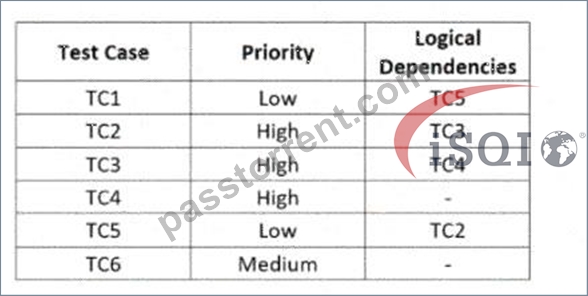
Which of the following test execution schedules is compatible with the logical dependencies and allows executing the test cases in priority order?
- A. TC4, TC6, TC3, TC2, TC5, TC1
- B. TC3, TC5, TC6, TC1, TC4, TC3
- C. TC4, TC3, TC2, TC6, TC5. TC1
- D. TC4, TC3, TC2, TC6, TC1, TC5
Answer: D
Explanation:
This answer is correct because it follows the logical dependencies and allows executing the test cases in priority order. TC4, TC3, and TC2 are executed first because they have the highest priority. TC6 is executed next because it has a logical dependency on TC2. TC1 is executed next because it has a logical dependency on TC5. Finally, TC5 is executed last because it has the lowest priority. References: ISTQB Certified Tester Foundation Level (CTFL) v4.0 documents
NEW QUESTION # 63
Which of the following statements refers to good testing practice to be applied regardless of the chosen software development model?
- A. Test objectives should be the same for all test levels, although the number of tests designed at various levels can vary significantly
- B. Involvement of testers in work product reviews should occur as early as possible to take advantage of the early testing principle
- C. Test levels should be defined such that the exit criteria of one level are part of the entry criteria for the next level
- D. Tests should be written in executable format before the code is written and should act as executable specifications that drive coding
Answer: B
Explanation:
The statement that refers to good testing practice to be applied regardless of the chosen software development model is option D, which says that involvement of testers in work product reviews should occur as early as possible to take advantage of the early testing principle. Work product reviews are static testing techniques, in which the work products of the software development process, such as the requirements, the design, the code, the test cases, etc., are examined by one or more reviewers, with or without the author, to identify defects, violations, or improvements. Involvement of testers in work product reviews can provide various benefits for the testing process, such as improving the test quality, the test efficiency, and the test communication. The early testing principle states that testing activities should start as early as possible in the software development lifecycle, and should be performed iteratively and continuously throughout the lifecycle. Applying the early testing principle can help to prevent, detect, and remove defects at an early stage, when they are easier, cheaper, and faster to fix, as well as to reduce the risk, the cost, and the time of the testing process. The other options are not good testing practices to be applied regardless of the chosen software development model, but rather specific testing practices that may or may not be applicable or beneficial for testing, depending on the context and the objectives of the testing activities, such as:
* Tests should be written in executable format before the code is written and should act as executable specifications that drive coding: This is a specific testing practice that is associated with test-driven development, which is an approach to software development and testing, in which the developers write automated unit tests before writing the source code, and then refactor the code until the tests pass.
Test-driven development can help to improve the quality, the design, and the maintainability of the code, as well as to provide fast feedback and guidance for the developers. However, test-driven development is not a good testing practice to be applied regardless of the chosen software development model, as it may not be feasible, suitable, or effective for testing in some contexts or situations, such as when the requirements are unclear, unstable, or complex, when the test automation tools or skills are not available or adequate, when the testing objectives or levels are not aligned with the unit testing, etc.
* Test levels should be defined such that the exit criteria of one level are part of the entry criteria for the next level: This is a specific testing practice that is associated with sequential software development models, such as the waterfall model, the V-model, or the W-model, in which the software development and testing activities are performed in a linear and sequential order, with well-defined phases, deliverables, and dependencies. Test levels are the stages of testing that correspond to the levels of integration of the software system, such as component testing, integration testing, system testing, and acceptance testing. Test levels should have clear and measurable entry criteria and exit criteria, which are the conditions that must be met before starting or finishing a test level. In sequential software development models, the exit criteria of one test level are usually part of the entry criteria for the next test level, to ensure that the software system is ready and stable for the next level of testing. However, this is not a good testing practice to be applied regardless of the chosen software development model, as it may not be relevant, flexible, or efficient for testing in some contexts or situations, such as when the software development and testing activities are performed in an iterative and incremental order, with frequent changes, feedback, and adaptations, as in agile software development models, such as Scrum, Kanban, or XP, when the test levels are not clearly defined or distinguished, or when the test levels are performed in parallel or concurrently, etc.
* Test objectives should be the same for all test levels, although the number of tests designed at various levels can vary significantly: This is a specific testing practice that is associated with uniform software development models, such as the spiral model, the incremental model, or the prototyping model, in which the software development and testing activities are performed in a cyclical and repetitive manner, with similar phases, deliverables, and processes. Test objectives are the goals or the purposes of testing, which can vary depending on the test level, the test type, the test technique, the test environment, the test stakeholder, etc. Test objectives can be defined in terms of the test basis, the test coverage, the test quality, the test risk, the test cost, the test time, etc. Test objectives should be specific, measurable, achievable, relevant, and time-bound, and they should be aligned with the project objectives and the quality characteristics. In uniform software development models, the test objectives may be the same for all test levels, as the testing process is repeated for each cycle or iteration, with similar focus, scope, and perspective of testing. However, this is not a good testing practice to be applied regardless of the chosen software development model, as it may not be appropriate, realistic, or effective for testing in some contexts or situations, such as when the software development and testing activities are performed in a hierarchical and modular manner, with different phases, deliverables, and dependencies, as in sequential software development models, such as the waterfall model, the V-model, or the W-model, when the test objectives vary according to the test levels, such as component testing, integration testing, system testing, and acceptance testing, or when the test objectives change according to the feedback, the
* learning, or the adaptation of the testing process, as in agile software development models, such as Scrum, Kanban, or XP, etc. References: ISTQB Certified Tester Foundation Level (CTFL) v4.0 sources and documents:
* ISTQB Certified Tester Foundation Level Syllabus v4.0, Chapter 1.1.1, Testing and the Software Development Lifecycle1
* ISTQB Certified Tester Foundation Level Syllabus v4.0, Chapter 1.2.1, Testing Principles1
* ISTQB Certified Tester Foundation Level Syllabus v4.0, Chapter 1.2.2, Testing Policies, Strategies, and Test Approaches1
* ISTQB Certified Tester Foundation Level Syllabus v4.0, Chapter 1.3.1, Testing in Software Development Lifecycles1
* ISTQB Certified Tester Foundation Level Syllabus v4.0, Chapter 2.1.1, Test Planning1
* ISTQB Certified Tester Foundation Level Syllabus v4.0, Chapter 2.1.2, Test Monitoring and Control1
* ISTQB Certified Tester Foundation Level Syllabus v4.0, Chapter 2.1.3, Test Analysis and Design1
* ISTQB Certified Tester Foundation Level Syllabus v4.0, Chapter 2.1.4, Test Implementation1
* ISTQB Certified Tester Foundation Level Syllabus v4.0, Chapter 2.1.5, Test Execution1
* ISTQB Certified Tester Foundation Level Syllabus v4.0, Chapter 2.1.6, Test Closure1
* ISTQB Glossary of Testing Terms v4.0, Work Product Review, Static Testing, Early Testing, Test-driven Development, Test Level, Entry Criterion, Exit Criterion, Test Objective, Test Basis, Test Coverage, Test Quality, Test Risk, Test Cost, Test Time2
NEW QUESTION # 64
The fact that defects are usually not evenly distributed among the various modules that make up a software application, but rather their distribution tend to reflect the Pareto principle:
- A. is expressed by the testing principle referred to as 'Defects cluster together'
- B. is expressed by the testing principle referred to as 'Bug prediction'
- C. is a false myth
- D. is expressed by the testing principle referred to as Tests wear out'
Answer: A
Explanation:
The fact that defects are usually not evenly distributed among the various modules that make up a software application, but rather their distribution tend to reflect the Pareto principle, is expressed by the testing principle referred to as 'Defects cluster together'. This principle states that a small number of modules contain most of the defects detected, or that a small number of causes are responsible for most of the defects. This principle can be used to guide the test analysis and design activities, by prioritizing the testing of the most critical or risky modules, or by applying more rigorous test techniques to them. Therefore, option C is the correct answer.
References: ISTQB Certified Tester Foundation Level Syllabus v4.01, Section 1.2.1, page 11; ISTQB Glossary v4.02, page 16.
NEW QUESTION # 65
......
Study HIGH Quality CTFL_Syll_4.0 Free Study Guides and Exams Tutorials: https://www.passtorrent.com/CTFL_Syll_4.0-latest-torrent.html
Download ISQI CTFL_Syll_4.0 Exam Dumps to Pass Exam Easily: https://drive.google.com/open?id=1Wl6xIVNke8TFlAcaOTyWv9r1fpnJN33c