


AACE International AACE-PSP Certification All-in-One Exam Guide Mar-2026
Get Real AACE-PSP Exam Dumps [Mar-2026] Practice Tests
NEW QUESTION # 77
In analyzing a logical chain of activities in a critical path method (CPM) schedule, what do differing total float values within that chain typically indicate?
- A. The schedule is projecting an "early completion".
- B. Certain activities in the critical path have no successors.
- C. Different calendars are assigned to certain activities in the logical chain.
- D. The schedule has too much detail to reflect an accurate critical path.
Answer: A
NEW QUESTION # 78
Estimate to complete (ETC) is __________________.
- A. The expected total cost of an activity, group of activities or the project
- B. The value of the completed work expressed in terms of the budget assigned to that work
- C. The costs actually incurred in accomplishing the work performed
- D. The expected remaining cost needed to complete an activity, group of activities or the project
Answer: D
Explanation:
Estimate to Complete (ETC) is the forecast of additional costs required to complete the remaining project work.
Option B refers to actual costs incurred (AC).
Option C refers to Estimate at Completion (EAC), which includes both actual costs and ETC.
Option D refers to Budgeted Cost of Work Performed (BCWP).
ETC is a critical concept for forecasting and project control as described in the PSP Study Guide.
NEW QUESTION # 79
Using the "normal" schedule, and assuming you are billing on the last day of the month for previous month and for appropriate partial months, how many invoices will you have for this project?
- A. 37.
- B. 36.
- C. 42.
- D. 40.
Answer: B
NEW QUESTION # 80
Is activity 7001 pictured correctly in the precedence diagram?
- A. Yes, except the early finish date is not shown.
- B. No, the start-to-start and finish-to-finish relationships are backwards.
- C. Yes, the duration is 48 days.
- D. No, the total float is not shown correctly.
Answer: C
NEW QUESTION # 81
Using the "normal" schedule, theoretically construct a hammock for activities 6001-6003. What is the duration of the hammock?
- A. 255 days
- B. 407 days
- C. 362 days
- D. 267 days
Answer: B
NEW QUESTION # 82
What problems can a soils engineer deal with on a project?
- A. Toxic soils.
- B. Archeological findings.
- C. Survey error.
- D. Hidden subsurface conditions.
Answer: D
NEW QUESTION # 83
Using the "normal" schedule, theoretically construct a hammock for activities 2001 through 2004. What is the duration of the hammock?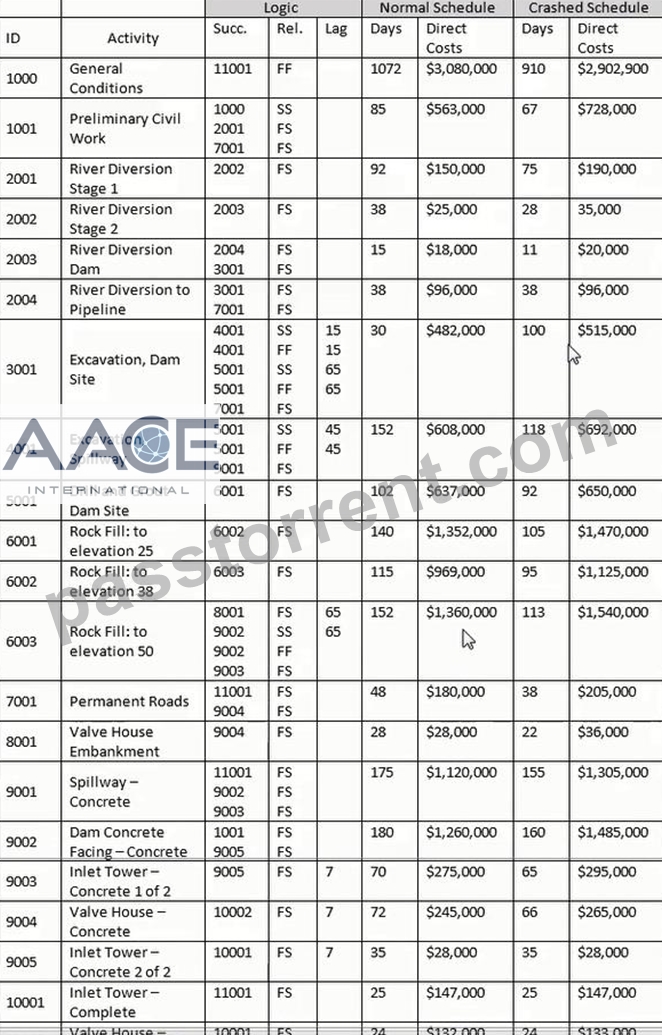
- A. 53 days
- B. 183 days
- C. 145 days
- D. 91 days
Answer: A
Explanation:
* Hammock Activities (2001-2004):
Activity 2001 ("River Diversion Stage 1"): Duration = 92 days.
Activity 2002: Starts immediately after 2001, duration = 38 days.
Activity 2003: Starts immediately after 2002, duration = 15 days.
Activity 2004: Starts immediately after 2003, duration = 38 days.
* Calculate the Duration:
Total duration = 92 + 38 + 15 + 38 = 183 days.
* Cross-Verification with Answer Options:
Option A: Incorrect. Underestimates.
Option C: Incorrect. Overestimates.
Option D: Incorrect. Overestimates.
Option B: Correct. Matches the calculated duration.
NEW QUESTION # 84
How many entities/subcontractors should a scheduled activity cover?
- A. More than one if the concurrent work cannot be split between subcontractors
- B. More than one it the activity is in a single calendar period
- C. Only one
- D. More than one it the subcontractors agree
Answer: C
NEW QUESTION # 85
Budgeted cost of work scheduled is _______________________.
- A. The expected total cost of an activity, group of activities or the project
- B. The value of the completed work expressed in terms of the budget assigned to that work
- C. The total authorized budget for accomplishing the project scope
- D. The sum of all budgets for work scheduled to be accomplished within a given time period
Answer: A
NEW QUESTION # 86
Using the normal schedule and excluding general conditions, which activities are NOT on the critical path?
- A. 5001,7001.8001,9001,9004,9005
- B. 7001, 8001, 9001. 9003. 9004. 10002
- C. 2003,8001.9001.9002,9005,10001
- D. 6001, 8001, 9001. 9002, 9004. 9005
Answer: A
Explanation:
Activities not on the critical path are those with positive float, meaning they can be delayed without affecting the overall project completion time. The determination of such activities requires performing a forward and backward pass calculation as per CPM (Critical Path Method) analysis principles (PSP Study Guide, Section 2.2.4, "Relationships").
For example:
Identify the critical path by analyzing total float values (typically, critical path activities have zero total float).
Exclude activities that do not fall on the critical path.
NEW QUESTION # 87
Under which circumstance should one perform resource-leveling calculations?
- A. Never, unless required by the contract.
- B. When the schedule is resource-loaded.
- C. When you believe that known resource limitations may override schedule logic.
- D. When the contract contains a provision for float-banking.
Answer: C
NEW QUESTION # 88
Is activity 7001 pictured correctly in the precedence diagram?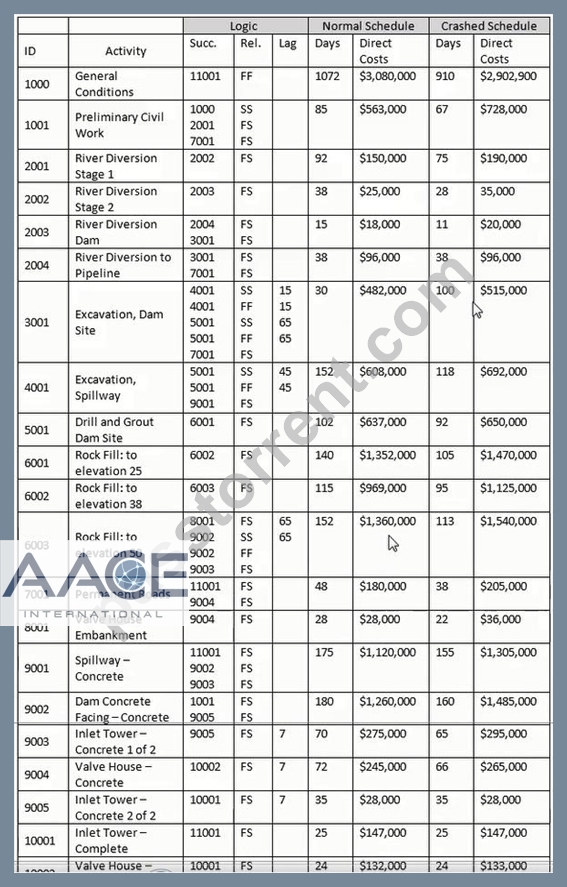
- A. Yes, except the early finish date is not shown.
- B. No, the start-to-start and finish-to-finish relationships are backwards.
- C. Yes, the duration is 48 days.
- D. No, the total float is not shown correctly.
Answer: C
NEW QUESTION # 89
Which of the following is NOT required when initially planning a project?
- A. Logical relationships between the tasks.
- B. The duration of each task.
- C. A schedule that identifies tasks required on a project.
- D. Resource Identification and leveling.
Answer: B
NEW QUESTION # 90
Using the normal schedule, what is the owner's total cost of the project?
- A. S12.953.600
- B. S12.990.000
- C. S13.990.600
- D. S13.102.900
Answer: A
NEW QUESTION # 91
What activities are concurrent to Activity 2001 in the "normal" schedule?
- A. 1000.
- B. 1001.
- C. 7001.
- D. 2003.
Answer: C
NEW QUESTION # 92
Using the "normal" schedule, what is the early finish date of activity 10002 and its total float?
- A. 12-18-03 and 25 days of float
- B. 12-18-03 and 4 days of float
- C. 12-27-03 and 24 days of float
- D. 12-17-03 and 4 days of float
Answer: D
NEW QUESTION # 93
Midway through the project you received an executed change order for this project, adding thirty-three days to the contract for weather delays. In its simplest form, how would your next project update display the changed condition?
- A. After Activity 1000, add a new Activity 1050 with a start-to-start relationship to Activity 1000, and tie the end of this new activity with a finish-to-finish relationship to the final activity of the project.
- B. After Activity 1001, add a new Activity 1011 with a finish-to-start relationship to Activity 1000, and tie the end of this new activity with a finish-to-start relationship to the final activity of the project.
- C. After Activity 1000, add a new Activity 1010 with a finish-to-start relationship to Activity 1000, and tie the end of this new activity with a finish-to-start relationship to the final activity of the project.
Answer: B
NEW QUESTION # 94
A good change management plan___________.
- A. involves only the project controls team
- B. tracks minor decisions
- C. is detailed during the planning phase
- D. is provided to stakeholders after it is created
Answer: C
Explanation:
Best Practices for Change Management Plans:
Effective plans are developed in the planning phase, ensuring all stakeholders understand how changes will be managed.
Evaluation of Options:
Option A: Incorrect. Stakeholders are involved during development, not just after.
Option C: Incorrect. A change management plan focuses on significant changes, not minor decisions.
Option D: Incorrect. It involves all stakeholders, not just the project controls team.
Option B: Correct. Change management plans are part of project planning.
Reference:
PSP Study Guide (2019), Sections on Critical Path Analysis, Float Management, and Change Management.
AACE Recommended Practices, RP 10S-90.
NEW QUESTION # 95
An earned value-based project control system can use either of which two budgets as the basis of its calculations?
- A. Direct or indirect cost.
- B. Labor hours or dollars.
- C. Linear feet or dollars.
- D. Earned or budgeted cost yearly.
Answer: B
Explanation:
An earned value management (EVM) system can base its calculations on labor hours or monetary values, depending on the nature of the project. Both methods are valid for tracking performance and forecasting outcomes.
Option B (direct or indirect cost) does not align with EVM's focus on performance metrics.
Option C confuses timeframes with budgeting principles.
Option D (linear feet or dollars) applies to physical progress tracking but not directly to EVM systems.
This is consistent with EVM principles as outlined in project control methodologies within the PSP materials.
NEW QUESTION # 96
What is the remaining work duration of Active D?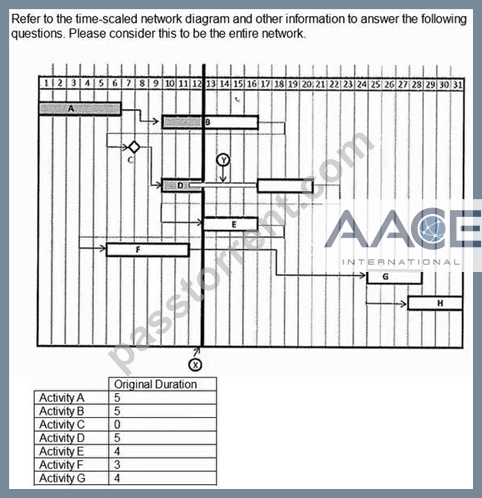
- A. 4.
- B. 8.
- C. 3.
- D. 0
Answer: A
NEW QUESTION # 97
Which of the following is the most important scheduling consideration for the BILCO contractual scope?
- A. Conforming CPM schedule to SDOT standards
- B. Update frequency
- C. Logical phasing lies
- D. Cost loading
Answer: C
NEW QUESTION # 98
What is a critical path method schedule?
- A. A graphical means of showing the important work
- B. List of work to be accomplished by responsible party and when it is to be accomplished
- C. The timeline of the riskiest work
- D. A network diagram of logically interconnected activities
Answer: D
Explanation:
* Definition of a Critical Path Method (CPM) Schedule:
CPM schedules are based on network diagrams that logically link activities, showing the sequence and dependencies between them.
These schedules identify the critical path, which is the longest path through the network, determining the project's shortest possible duration.
* Evaluation of Options:
Option A: Incorrect. While CPM schedules do include tasks and timelines, the defining feature is the logical interconnection of activities.
Option B: Incorrect. CPM schedules are not limited to "risky" work; they show all activities.
Option C: Incorrect. CPM schedules use network diagrams, not just graphical representations.
Option D: Correct. The network diagram is the key characteristic of CPM schedules.
NEW QUESTION # 99
Determine the correct formula and date for the late finish for Activity 6002.
- A. LS of 6003 less 1 day equaling 09 Mar 2023
- B. LS of 6003 plus 1 day equaling 09 Mar 2022
- C. LS of 6003 plus 1 day equaling 09 Mar 2023
- D. LS of 6003 less 1 day equaling 09 Mar 2022
Answer: A
Explanation:
* Determining the Late Finish (LF) of Activity 6002 involves analyzing its successor activity, 6003, and considering the lag (if any).
* By subtracting 1 day from the Late Start (LS) of 6003, the Late Finish (LF) of 6002 is derived. The date calculation aligns with this logic, making 09 Mar 2023 the correct date.
* Reference: PSP Study Guide, Section 2.2.5 - Constraints and Calendars, and Appendix A - Example CPM Problems, which detail LF and LS calculations.
NEW QUESTION # 100
Assuming that you had only one crane capable of 30 lifts per day, 3 column pours requiring 28 lifts each, plus associated assorted work requiring an additional 150 lifts, what is the minimum planned working duration for this work?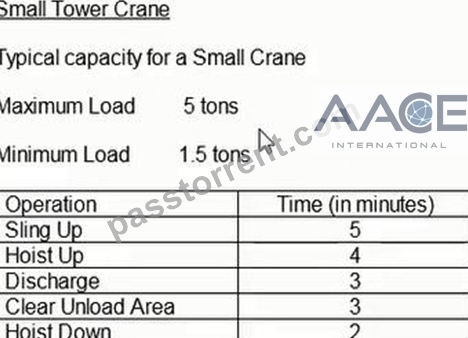
- A. 8 work days
- B. 15 workdays
- C. 18 work days
- D. 7 work days
Answer: C
Explanation:
* Calculation of Total Lifts Required:
3 column pours = 28×3=8428 \times 3 = 8428×3=84.
Additional lifts = 150150150.
Total lifts = 84+150=23484 + 150 = 23484+150=234.
* Lifts Per Day with One Crane:
1 crane performs 30 lifts per day.
* Required Duration:
Minimum planned working duration = ⌈234÷30⌉=18\lceil 234 \div 30 \rceil = 18⌈234÷30⌉=18.
* Verification with PSP Guidelines:
Aligning workload with equipment capacity ensures practical schedule planning (Ref: PSP Study Guide, Chapter 2B: Workload Balancing).
NEW QUESTION # 101
......
AACE International is a professional association that specializes in cost engineering, project management, and planning and scheduling. The association provides certifications to individuals who demonstrate their proficiency in these fields. One of the most popular certifications offered by AACE International is the Planning & Scheduling Professional (PSP) Certification Exam.
Last AACE-PSP practice test reviews: Practice Test AACE International dumps: https://www.passtorrent.com/AACE-PSP-latest-torrent.html
Try AACE-PSP Free Now! Real Exam Question Answers: https://drive.google.com/open?id=11Ecyk0dGETjTWyU0uBQGbkCkW-n1W4dF