


2025 Updated Salesforce MuleSoft-Platform-Architect-I Dumps PDF - Want To Pass MuleSoft-Platform-Architect-I Fast
MuleSoft-Platform-Architect-I Practice Exam Dumps - 99% Marks In Salesforce Exam
Salesforce MuleSoft-Platform-Architect-I Exam Syllabus Topics:
| Topic | Details |
|---|---|
| Topic 1 |
|
| Topic 2 |
|
| Topic 3 |
|
| Topic 4 |
|
NEW QUESTION # 10
Refer to the exhibit.
What is the best way to decompose one end-to-end business process into a collaboration of Experience, Process, and System APIs?
A) Handle customizations for the end-user application at the Process API level rather than the Experience API level B) Allow System APIs to return data that is NOT currently required by the identified Process or Experience APIs C) Always use a tiered approach by creating exactly one API for each of the 3 layers (Experience, Process and System APIs) D) Use a Process API to orchestrate calls to multiple System APIs, but NOT to other Process APIs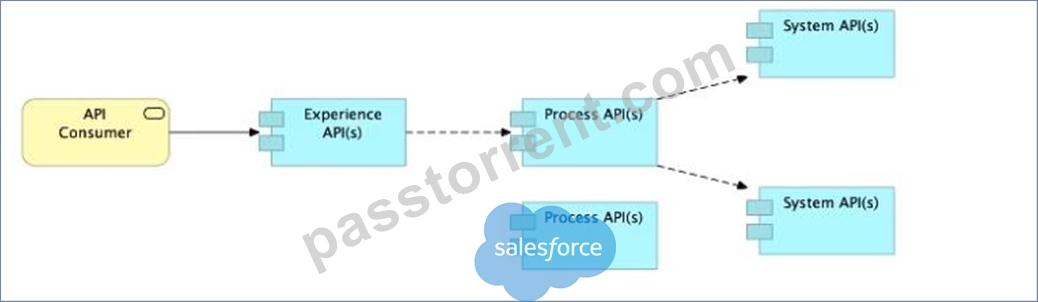
- A. Option D
- B. Option A
- C. Option B
- D. Option C
Answer: C
Explanation:
Correct Answe r: Allow System APIs to return data that is NOT currently required by the identified Process or Experience APIs.
*****************************************
>> All customizations for the end-user application should be handled in "Experience API" only. Not in Process API
>> We should use tiered approach but NOT always by creating exactly one API for each of the 3 layers. Experience APIs might be one but Process APIs and System APIs are often more than one. System APIs for sure will be more than one all the time as they are the smallest modular APIs built in front of end systems.
>> Process APIs can call System APIs as well as other Process APIs. There is no such anti-design pattern in API-Led connectivity saying Process APIs should not call other Process APIs.
So, the right answer in the given set of options that makes sense as per API-Led connectivity principles is to allow System APIs to return data that is NOT currently required by the identified Process or Experience APIs. This way, some future Process APIs can make use of that data from System APIs and we need NOT touch the System layer APIs again and again.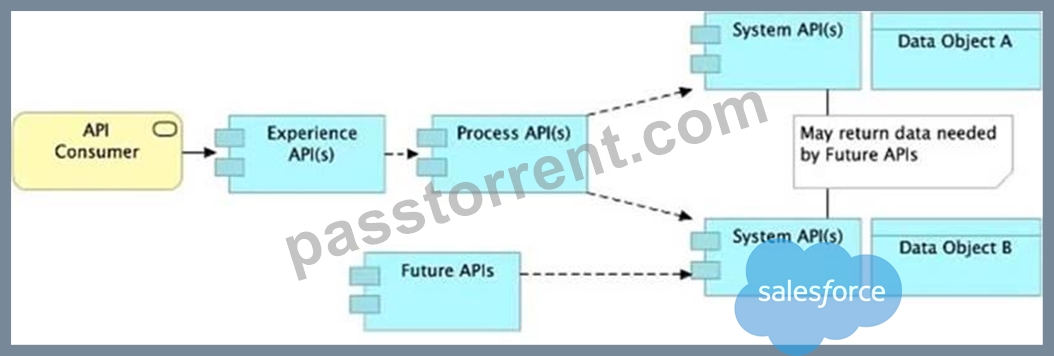
NEW QUESTION # 11
A company is building an application network using MuleSoft's recommendations for various API layers.
What is the main (default) role of a process API in an application network?
- A. To automate parts of business processes by coordinating and orchestrating the invocation of other APIs in the application network
- B. To manage and process the secure direct communication between a back-end system and an end-user client of mobile device in the application network
- C. To secure, Manage, and process communication with specific types of end-user client applications or devices in the application network
- D. To secure and optimize the data synchronization processing of large data dumps between back-end systems
Answer: A
Explanation:
Role of Process API in API-led Connectivity:
In MuleSoft's API-led connectivity approach, a Process API is used to coordinate, aggregate, and orchestrate data from various System APIs. It is primarily responsible for implementing business logic that spans multiple backend systems or entities, transforming and combining data as needed to support business processes.
Process APIs are not directly exposed to end-user clients; rather, they work between System APIs and Experience APIs, providing business logic and orchestration capabilities.
Evaluating the Options:
Option A: Process APIs are not typically responsible for large data dumps or data synchronization. That function would be handled by a System API or a specialized batch process.
Option B: Managing direct, secure communication between back-end systems and end-user clients is typically the role of Experience APIs rather than Process APIs.
Option C (Correct Answer): Process APIs are designed to coordinate and orchestrate calls to multiple other APIs in the network, which supports the automation of business processes.
Option D: Securing and managing communication with end-user clients is typically the role of Experience APIs, not Process APIs.
Conclusion:
Option C is the correct answer, as the main role of a Process API is to coordinate and orchestrate interactions between other APIs, enabling business processes to function seamlessly across multiple systems.
Refer to MuleSoft's API-led connectivity documentation for further explanation of the roles and responsibilities of Process APIs in an application network.
NEW QUESTION # 12
When can CloudHub Object Store v2 be used?
- A. To store payloads with an average size greater than 15MB
- B. To store information in Mule 4 Object Store v1
- C. To store an unlimited number of key-value pairs
- D. To store key-value pairs with keys up to 300 characters
Answer: D
Explanation:
CloudHub Object Store v2 is a managed key-value store provided by MuleSoft to support various use cases where temporary data storage is required. Here's why Option D is correct:
Key Length Support: Object Store v2 allows storage of keys with a length of up to 300 characters, making it suitable for applications needing flexible and descriptive keys.
Limitations on Size:
Object Store v2 is not intended for large payload storage and has a recommended size limit below 10 MB for each value. Payloads exceeding 15 MB may cause performance issues and are better suited to a file storage system or database.
Option B is incorrect because storing payloads above 15 MB exceeds Object Store's optimal usage specifications.
Key-Value Limits: Object Store v2 is designed for moderate, transient storage needs, and does not support unlimited storage. Thus, Option A is incorrect.
Backward Compatibility: Object Store v2 does not support Mule 4 applications running Object Store v1. Option C is incorrect as Object Store v1 and v2 are distinct.
Reference
For more on CloudHub Object Store v2, refer to MuleSoft documentation on Object Store limitations and configuration.
NEW QUESTION # 13
Question 10: Skipped
An API implementation returns three X-RateLimit-* HTTP response headers to a requesting API client. What type of information do these response headers indicate to the API client?
- A. A correlation ID that should be sent in the next request
- B. The remaining capacity allowed by the API implementation
- C. The error codes that result from throttling
- D. The HTTP response size
Answer: B
Explanation:
Correct Answer : The remaining capacity allowed by the API implementation.
*****************************************
>> Reference: https://docs.mulesoft.com/api-manager/2.x/rate-limiting-and-throttling-sla-based-policies#response-headers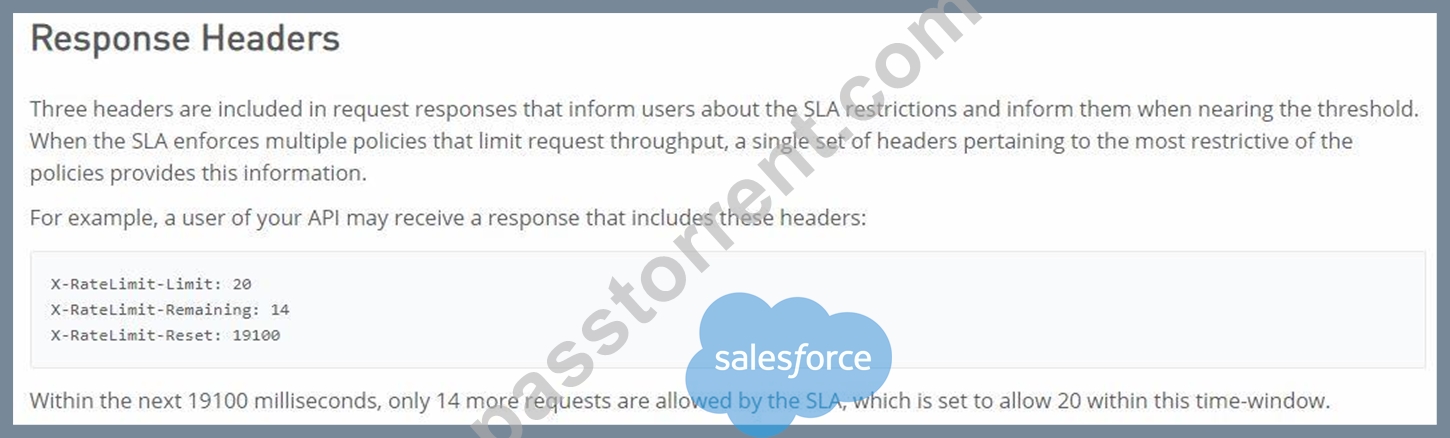
NEW QUESTION # 14
4A developer for a transportation organization is implementing exactly one processing functionality in a Reservation Mule application to process and store passenger records. This Reservation application will be deployed to multiple CloudHub workers/replicas. It is possible that several external systems could send duplicate passenger records to the Reservation application.
An appropriate storage mechanism must be selected to help the Reservation application process each passenger record exactly once as much as possible. The selected storage mechanism must be shared by all the CloudHub workers/replicas in order to synchronize the state information to assist attempting exactly once processing of each passenger record by the deployed Reservation Mule application.
Which type of simple storage mechanism in Anypoint Platform allows the Reservation Mule application to update and share data between the CloudHub workers/replicas exactly once, with minimal development effort?
- A. Runtime Fabric Object Store
- B. Non-persistent Object Store
- C. In-memory Mule Object Store
- D. Persistent Object Store
Answer: D
Explanation:
Processing Requirements and Storage Mechanism:
The Reservation Mule application will be deployed to multiple CloudHub workers/replicas, meaning that each worker must share state information to handle records exactly once. This requires a shared storage mechanism where state can be stored and accessed by multiple instances to avoid duplicate processing of the same records.
A Persistent Object Store in Anypoint Platform can be used to store records in a way that is accessible across multiple workers, providing a reliable mechanism for "exactly once" processing.
Evaluating the Options:
Option A (Correct Answer): A Persistent Object Store is designed to retain data across different application instances and can be shared by all workers on CloudHub. It helps achieve idempotency by ensuring that a record is processed exactly once.
Option B: Runtime Fabric Object Store is used for applications deployed in Anypoint Runtime Fabric, not CloudHub. This option would not be compatible with the CloudHub deployment.
Option C: A Non-persistent Object Store does not retain data across application restarts or different instances, making it unsuitable for the requirement of synchronized storage for exactly-once processing.
Option D: An In-memory Mule Object Store is local to each worker and is not shared across instances, so it does not meet the requirement for a shared storage mechanism accessible to all CloudHub workers.
Conclusion:
Option A is the correct answer, as a Persistent Object Store allows data sharing across multiple CloudHub workers, enabling them to synchronize and achieve "exactly once" processing of passenger records with minimal development effort.
Refer to MuleSoft's documentation on Object Store configurations and usage for best practices on handling state across distributed instances.
NEW QUESTION # 15
A customer wants to host their MuleSoft applications in CloudHub 1.0, and these applications should be available at the domain https://api.acmecorp.com.
After creating a dedicated load balancer (DLB) called acme-dib-prod, which further action must the customer take to complete the configuration?
- A. Configure the DLB with a TLS certificate for acme-dib-prod.Jb.anypointdns.net and create a CNAME record from api.acmecorp:com to acme-dlb-prod.lb.anypointdns.net
- B. Configure the DLB with a TLS certificate for api.acmecorp.com and create an A record for api.acmecorp.com to the public IP addresses associated with their DLB
- C. Configure the DLB with a TLS certificate for aplacmecorp.com and create a CNAME record from api.aomecorp.com to acme-dib-prod.ei.cloubhub.io
- D. Configure the DLB with a TLS certificate for api.acmecorp.com and create a CNAME record from api.acmecorp.com to acme-dib-prod.|lb.anypointdns.net
Answer: D
Explanation:
When setting up a custom domain for MuleSoft applications hosted on CloudHub 1.0 using a Dedicated Load Balancer (DLB), follow these steps:
Set Up the TLS Certificate: Configure the DLB (acme-dib-prod) with a TLS certificate that covers the custom domain api.acmecorp.com. This certificate will allow HTTPS traffic to be securely directed through the DLB to your Mule applications.
DNS Configuration with CNAME:
Create a CNAME record that points api.acmecorp.com to the DLB hostname acme-dib-prod.lb.anypointdns.net.
The CNAME record enables the custom domain to resolve to the DLB provided by MuleSoft's Anypoint Platform. This CNAME mapping directs all traffic to the correct DLB for processing and load distribution.
Why Option B is Correct:
A CNAME record provides the necessary aliasing to acme-dib-prod.lb.anypointdns.net, which is the endpoint managed by Anypoint Platform for your DLB.
Option B also correctly identifies the need to configure the DLB with a TLS certificate specifically for api.acmecorp.com rather than for the DLB's internal hostname.
of Incorrect Options:
Options that suggest configuring the DLB with a TLS certificate for the DLB's internal hostname or using an A record are not suitable in this scenario. MuleSoft CloudHub 1.0 DLBs work with CNAME records to provide flexible and scalable domain management, and a direct IP (A record) is not supported for these load balancers.
Reference
For more information on configuring custom domains and DLBs on CloudHub 1.0, refer to the MuleSoft documentation on DLB setup and DNS configuration.
NEW QUESTION # 16
A company stores financial transaction data in two legacy systems. For each legacy system, a separate, dedicated System API (SAPI) exposes data for that legacy system. A Process API (PAPI) merges the data retrieved from ail of the System APIs into a common format. Several API clients call the PAPI through its public domain name.
The company now wants to expose a subset of financial data to a newly developed mobile application that uses a different Bounded Context Data Model. The company wants to follow MuleSoft's best practices for building out an effective application network.
Following MuleSoft's best practices, how can the company expose financial data needed by the mobile application in a way that minimizes the impact on the currently running API clients, API implementations, and support asset reuse?
- A. Add two new Experience APIs (EAPI-i and EAPI-2}.
Add Mobile PAPI-2 to expose the Intended subset of financial data as requested.
Both PAPIs access the Legacy Systems via SAPI-1 and SAP]-2. - B. Add two new Experience APIs (EAPI-i and EAPI-2}.
Add Mobile PAPI-2 to expose the Intended subset of financial data as requested.
Both PAPIs access the Legacy Systems via SAPI-1 and SAP]-2. - C. Develop and deploy is new PAPI implementation with data transformation and ... login to support this required endpoints of both mobile and web clients.
Deploy an API Proxy with an endpoint from API Manager that redirect the existing PAPI endpoints to the new PAPI. - D. Create a new mobile Experince API (EAPI) chat exposes that subset of PAPI endpoints.
Add transformtion login to the mobile Experince API implementation to make mobile data compatible with the required PAPIs.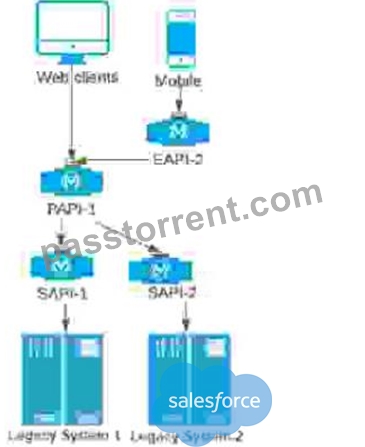
Answer: A
Explanation:
To achieve the goal of exposing financial data to a new mobile application while following MuleSoft's best practices, the company should follow an API-led connectivity approach. This approach ensures minimal disruption to existing clients, maximizes reusability, and respects the separation of concerns across API layers.
of Solution:
Experience APIs for Client-Specific Requirements:
Create two new Experience APIs (EAPI-1 and EAPI-2) for the mobile application, tailored to meet the specific data and format requirements of the mobile application. These APIs encapsulate the client-specific needs and provide a custom interface without impacting other clients.
Process API Layer for Data Transformation:
By adding Mobile PAPI-2, we allow the mobile application to access the required subset of data, formatted according to the mobile application's requirements. This approach ensures that data transformation and aggregation are handled in the Process layer, maintaining consistency and reusability across different applications.
Reuse of System APIs:
Both the new Mobile PAPI-2 and existing PAPI-1 access data from System APIs (SAPI-1 and SAPI-2), which continue to expose data from each legacy system in a consistent, reusable manner. This avoids duplicating logic and ensures that data access remains centralized and manageable.
Why Option A is Correct:
Option A aligns with MuleSoft's best practices by isolating client-specific requirements in the Experience layer, utilizing Process APIs for data orchestration and transformation, and maintaining reusable System APIs for backend access.
This approach also ensures that the current API clients are not impacted, as new clients (e.g., the mobile app) interact with newly defined Experience APIs without modifying the existing API setup.
of Incorrect Options:
Option B: This option seems similar but lacks clarity on the separation of mobile-specific requirements and does not explicitly mention data transformation, which is essential in this scenario.
Option C: Creating a single mobile Experience API that exposes a subset of PAPI endpoints directly adds unnecessary complexity and may violate the separation of concerns, as transformation logic should not be in the Experience layer.
Option D: Deploying a new PAPI and using an API Proxy to redirect existing endpoints would add unnecessary complexity, disrupt the current API clients, and increase maintenance efforts.
Reference
For additional guidance, refer to MuleSoft documentation on API-led connectivity best practices and best practices for structuring Experience, Process, and System APIs.
NEW QUESTION # 17
Say, there is a legacy CRM system called CRM-Z which is offering below functions:
1. Customer creation
2. Amend details of an existing customer
3. Retrieve details of a customer
4. Suspend a customer
- A. Implement different system APIs named createCustomerInCRMZ, amendCustomerInCRMZ, retrieveCustomerFromCRMZ and suspendCustomerInCRMZ as they are modular and has seperation of concerns
- B. Implement a system API named customerManagement which has all the functionalities wrapped in it as various operations/resources
- C. Implement different system APIs named createCustomer, amendCustomer, retrieveCustomer and suspendCustomer as they are modular and has seperation of concerns
Answer: C
Explanation:
Correct Answer : Implement different system APIs named createCustomer, amendCustomer, retrieveCustomer and suspendCustomer as they are modular and has seperation of concerns
*****************************************
>> It is quite normal to have a single API and different Verb + Resource combinations. However, this fits well for an Experience API or a Process API but not a best architecture style for System APIs. So, option with just one customerManagement API is not the best choice here.
>> The option with APIs in createCustomerInCRMZ format is next close choice w.r.t modularization and less maintenance but the naming of APIs is directly coupled with the legacy system. A better foreseen approach would be to name your APIs by abstracting the backend system names as it allows seamless replacement/migration of any backend system anytime. So, this is not the correct choice too.
>> createCustomer, amendCustomer, retrieveCustomer and suspendCustomer is the right approach and is the best fit compared to other options as they are both modular and same time got the names decoupled from backend system and it has covered all requirements a System API needs.
NEW QUESTION # 18
Mule applications that implement a number of REST APIs are deployed to their own subnet that is inaccessible from outside the organization.
External business-partners need to access these APIs, which are only allowed to be invoked from a separate subnet dedicated to partners - called Partner-subnet. This subnet is accessible from the public internet, which allows these external partners to reach it.
Anypoint Platform and Mule runtimes are already deployed in Partner-subnet. These Mule runtimes can already access the APIs.
What is the most resource-efficient solution to comply with these requirements, while having the least impact on other applications that are currently using the APIs?
- A. Implement (or generate) an API proxy Mule application for each of the APIs, then deploy the API proxies to the Mule runtimes
- B. Redeploy the API implementations to the same servers running the Mule runtimes
- C. Duplicate the APIs as Mule applications, then deploy them to the Mule runtimes
- D. Add an additional endpoint to each API for partner-enablement consumption
Answer: A
NEW QUESTION # 19
To minimize operation costs, a customer wants to use a CloudHub 1.0 solution. The customer's requirements are:
* Separate resources with two Business groups
* High-availability (HA) for all APIs
* Route traffic via Dedicated load balancer (DLBs)
* Separate environments into production and non-production
Which solution meets the customer's needs?
- A. One production and one non-production Virtual Private Cloud (VPC).
Use availability zones to differentiate between Business groups.
Allocate maximum CIDR per VPCs to ensure HA across availability zones - B. One production and one non-production Virtual Private Cloud (VPC) per Business group.
Minimize CIDR aligning with projected application total.
Divide availability zones during deployment of APIs for HA. - C. One production and one non-production Virtual Private Claud (VPC).
Configure subnet to differentiate between business groups.
Allocate maximum CIDR per VPCs to make it easier to add Child groups.
Span VPC to cover three availability zones. - D. One production and one non-production Virtual Private Cloud (VPC) per Business group.
Minimize CIDR aligning with projected application total.
Choose a MuleSoft CloudHub 1.0 region with multiple availability zones.
Deploy multiple workers for HA,
Answer: D
Explanation:
Understanding the Requirements:
Business Groups: The solution must support two business groups, which typically require separate VPCs for logical separation.
High Availability (HA): Requires deploying resources across multiple availability zones.
Dedicated Load Balancer (DLB): Traffic should be routed via DLBs, which operate within VPCs on CloudHub.
Separate Environments: There needs to be separation between production and non-production environments.
Evaluating the Options:
Option A: Using a single production and non-production VPC and differentiating business groups via availability zones is not ideal as it does not provide full separation for each business group, and using maximum CIDR allocation is wasteful.
Option B (Correct Answer): Creating separate production and non-production VPCs per business group with minimized CIDR blocks, multiple availability zones, and multiple workers per application for HA meets all requirements effectively.
Option C: While this option separates VPCs per business group, it does not fully address the requirement for HA across availability zones by specifying multi-zone deployment only during API deployment, which may not guarantee redundancy.
Option D: Configuring subnets to differentiate business groups within a single production and non-production VPC does not fully separate the business groups, which is a requirement.
Conclusion:
Option B is the best choice as it meets the requirements for high availability, business group separation, and cost efficiency by using minimized CIDR allocations and deploying multiple workers across availability zones.
For further reference, refer to MuleSoft's documentation on VPC configuration and high availability deployment strategies.
NEW QUESTION # 20
A company uses a hybrid Anypoint Platform deployment model that combines the EU control plane with customer-hosted Mule runtimes. After successfully testing a Mule API implementation in the Staging environment, the Mule API implementation is set with environment-specific properties and must be promoted to the Production environment. What is a way that MuleSoft recommends to configure the Mule API implementation and automate its promotion to the Production environment?
- A. Bundle properties files for each environment into the Mule API implementation's deployable archive, then promote the Mule API implementation to the Production environment using Anypoint CLI or the Anypoint Platform REST APIsB.
- B. Modify the Mule API implementation's properties in the API Manager Properties tab, then promote the Mule API implementation to the Production environment using API Manager
- C. Use an API policy to change properties in the Mule API implementation deployed to the Staging environment and another API policy to deploy the Mule API implementation to the Production environment
- D. Modify the Mule API implementation's properties in Anypoint Exchange, then promote the Mule API implementation to the Production environment using Runtime Manager
Answer: A
Explanation:
Correct Answer : Bundle properties files for each environment into the Mule API implementation's deployable archive, then promote the Mule API implementation to the Production environment using Anypoint CLI or the Anypoint Platform REST APIs
*****************************************
>> Anypoint Exchange is for asset discovery and documentation. It has got no provision to modify the properties of Mule API implementations at all.
>> API Manager is for managing API instances, their contracts, policies and SLAs. It has also got no provision to modify the properties of API implementations.
>> API policies are to address Non-functional requirements of APIs and has again got no provision to modify the properties of API implementations.
So, the right way and recommended way to do this as part of development practice is to bundle properties files for each environment into the Mule API implementation and just point and refer to respective file per environment.
NEW QUESTION # 21
An organization is implementing a Quote of the Day API that caches today's quote.
What scenario can use the GoudHub Object Store via the Object Store connector to persist the cache's state?
- A. When there is one CloudHub deployment of the API implementation to three CloudHub workers that must share the cache state
- B. When there are two CloudHub deployments of the API implementation by two Anypoint Platform business groups to the same CloudHub region that must share the cache state
- C. When there is one deployment of the API implementation to CloudHub and anottV deployment to a customer-hosted Mule runtime that must share the cache state
- D. When there are three CloudHub deployments of the API implementation to three separate CloudHub regions that must share the cache state
Answer: A
Explanation:
Correct Answer : When there is one CloudHub deployment of the API implementation to three CloudHub workers that must share the cache state.
*****************************************
Key details in the scenario:
>> Use the CloudHub Object Store via the Object Store connector
Considering above details:
>> CloudHub Object Stores have one-to-one relationship with CloudHub Mule Applications.
>> We CANNOT use an application's CloudHub Object Store to be shared among multiple Mule applications running in different Regions or Business Groups or Customer-hosted Mule Runtimes by using Object Store connector.
>> If it is really necessary and very badly needed, then Anypoint Platform supports a way by allowing access to CloudHub Object Store of another application using Object Store REST API. But NOT using Object Store connector.
So, the only scenario where we can use the CloudHub Object Store via the Object Store connector to persist the cache's state is when there is one CloudHub deployment of the API implementation to multiple CloudHub workers that must share the cache state.
NEW QUESTION # 22
A TemperatureSensors API instance is defined in API Manager in the PROD environment of the CAR_FACTORY business group. An AcmelemperatureSensors Mule application implements this API instance and is deployed from Runtime Manager to the PROD environment of the CAR_FACTORY business group. A policy that requires a valid client ID and client secret is applied in API Manager to the API instance.
Where can an API consumer obtain a valid client ID and client secret to call the AcmeTemperatureSensors Mule application?
- A. In secrets manager, request access to the Shared Secret static username/password
- B. In access management, from the PROD environment of the CAR_FACTORY business group
- C. In API Manager, from the PROD environment of the CAR_FACTORY business group
- D. In Anypoint Exchange, from an API client application that has been approved for the TemperatureSensors API instance
Answer: D
Explanation:
When an API policy requiring a client ID and client secret is applied to an API instance in API Manager, API consumers must obtain these credentials through a registered client application. Here's how it works:
Anypoint Exchange and Client Applications:
To access secured APIs, API consumers need to create or register a client application in Anypoint Exchange. This process involves requesting access to the specific API, and once approved, the consumer can retrieve the client ID and client secret associated with the application.
Why Option D is Correct:
Option D accurately describes the process, as the client ID and client secret are generated and managed within Anypoint Exchange. API consumers can use these credentials to authenticate with the TemperatureSensors API.
of Incorrect Options:
Option A (secrets manager) is incorrect because client credentials for API access are not managed via secrets manager.
Option B (API Manager) is incorrect as API Manager manages policies but does not provide client-specific credentials.
Option C (Access Management) does not apply, as Access Management is primarily used for user roles and permissions, not API client credentials.
Reference
For further details on managing client applications in Anypoint Exchange, consult MuleSoft documentation on client application registration and API security policies.
NEW QUESTION # 23
An enterprise is embarking on the API-led digital transformation journey, and the central IT team has started to define System APIs. Currently there is no Enterprise Data Model being defined within the enterprise, and the definition of a clean Bounded Context Data Model requires too much effort.
According to MuleSoft's recommended guidelines, how should the System API data model be defined?
- A. If there are misspellings of the data fields in the back-end system, Systerm APIs should not correct it, and expose it as-is to mirror the back-end systems
- B. The data model of the System APIs should make use of data types that approximately mirror those from the back-end systems
- C. The System APIs should expose all back-end system fields
- D. The data model should define its own naming convention, and not follow the same naming as the back-end systems
Answer: B
Explanation:
When defining data models for System APIs without an established Enterprise Data Model, MuleSoft recommends mirroring the back-end systems' data types to achieve quick and effective integration without adding complexity. This approach has several benefits:
Alignment with Backend Systems:
Mirroring data types ensures consistency with backend data sources, which simplifies integration, reduces mapping requirements, and minimizes potential data transformation issues.
Flexibility for Future Enhancements:
By retaining close alignment with backend data structures, System APIs can evolve to support an Enterprise Data Model in the future without immediate restructuring.
of Incorrect Options:
Option A (exposing misspellings) is not recommended as System APIs should still ensure a professional and coherent interface.
Option C (custom naming) complicates the API structure without adding immediate value in the absence of a clear data model.
Option D (exposing all fields) is unnecessary and can reduce performance and add complexity.
Reference
Refer to MuleSoft best practices for data modeling in System APIs for additional information on mirroring backend systems.
NEW QUESTION # 24
Which scenario is suited for MUnit tests instead of integration tests?
- A. For tests that are implemented using SoapUI
- B. When no mocking is permissible
- C. For read-only interactions to any dependencies (such as other web APIs)
- D. When testing does not require knowledge of implementation details
Answer: C
Explanation:
MUnit is MuleSoft's testing framework for creating and running automated tests within Anypoint Studio. It is specifically designed for unit testing Mule applications and is best suited when testing doesn't require understanding the inner workings or implementation details of the components being tested.
Ideal Use Cases for MUnit:
MUnit is optimal when testing individual flows, functions, or components in isolation. This type of testing focuses on verifying the behavior of each unit without needing to understand the complete system.
Since unit tests do not require external integrations or dependencies to be live, mocking is commonly used in MUnit to simulate the behavior of external services and APIs.
Why Option B is Correct:
Option B aligns with the concept of unit testing, where the emphasis is on testing functionality rather than system integration. Integration tests, on the other hand, would require implementation knowledge and live endpoints, making them unsuitable for MUnit's scope.
of Incorrect Options:
Option A (read-only interactions) and Option C (no mocking) do not suit MUnit's typical testing environment as MUnit is designed with mocking capabilities to simulate dependencies.
Option D (SoapUI-based tests) suggests an external testing tool, while MUnit is specific to MuleSoft.
Reference
For more on MUnit best practices, refer to MuleSoft's MUnit documentation.
NEW QUESTION # 25
What Mule application can have API policies applied by
Anypoint Platform to the endpoint exposed by that Mule application?
A) A Mule application that accepts requests over HTTP/1.x
B) A Mule application that accepts JSON requests over TCP but is NOT required to provide a response C) A Mute application that accepts JSON requests over WebSocket D) A Mule application that accepts gRPC requests over HTTP/2
- A. Option A
- B. Option D
- C. Option B
- D. Option C
Answer: A
Explanation:
Correct Answe r: Option A
*****************************************
>> Anypoint API Manager and API policies are applicable to all types of HTTP/1.x APIs.
>> They are not applicable to WebSocket APIs, HTTP/2 APIs and gRPC APIs
NEW QUESTION # 26
Which statement is true about Spike Control policy and Rate Limiting policy?
- A. All requests are rejected after the limit is reached in Rate Limiting policy, whereas the requests are queued in Spike Control policy after the limit is reached
- B. In a clustered environment, the Rate Limiting.and Spike Control policies are applied to each node in the cluster
- C. In order to apply Rate Limiting and Spike Control policies, a contract to bind client application and API is needed for both
- D. To protect Experience APIs by limiting resource consumption, Rate Limiting policy must be applied
Answer: B
Explanation:
Understanding Spike Control and Rate Limiting Policies:
Spike Control Policy: Limits the number of requests processed by the API in a short time to handle sudden bursts of traffic. It does not queue requests but rejects any request that exceeds the allowed burst rate.
Rate Limiting Policy: Sets a limit on the number of requests that an API can handle within a given timeframe. Once the limit is reached, additional requests are rejected.
Evaluating the Options:
Option A: Incorrect. In both Spike Control and Rate Limiting policies, requests are rejected once the limit is reached. Spike Control does not queue requests; it only controls the burst rate by rejecting excessive requests.
Option B (Correct Answer): In a clustered environment, each node independently enforces the Rate Limiting and Spike Control policies, meaning that the limits apply to each node separately. This ensures that each node can control its own resource usage independently within the cluster.
Option C: This is partially correct, as Rate Limiting is often used to protect Experience APIs, but Spike Control could also be useful in limiting resource consumption under high burst conditions.
Option D: Incorrect. Although a contract is required to enforce client-specific policies, Rate Limiting and Spike Control do not require a contract to function for general traffic control.
Conclusion:
Option B is the correct answer because, in a clustered environment, Rate Limiting and Spike Control policies apply separately to each node, helping each instance to manage its own load.
For more information, refer to MuleSoft's documentation on applying Rate Limiting and Spike Control policies in a clustered environment.
NEW QUESTION # 27
What are 4 important Platform Capabilities offered by Anypoint Platform?
- A. API Design and Development, API Runtime Execution and Hosting, API Operations and Management, API Consumer Engagement
- B. API Design and Development, API Deprecation, API Versioning, API Consumer Engagement
- C. API Design and Development, API Runtime Execution and Hosting, API Versioning, API Deprecation
- D. API Versioning, API Runtime Execution and Hosting, API Invocation, API Consumer Engagement
Answer: A
Explanation:
Correct Answer : API Design and Development, API Runtime Execution and Hosting, API Operations and Management, API Consumer Engagement
*****************************************
>> API Design and Development - Anypoint Studio, Anypoint Design Center, Anypoint Connectors
>> API Runtime Execution and Hosting - Mule Runtimes, CloudHub, Runtime Services
>> API Operations and Management - Anypoint API Manager, Anypoint Exchange
>> API Consumer Management - API Contracts, Public Portals, Anypoint Exchange, API Notebooks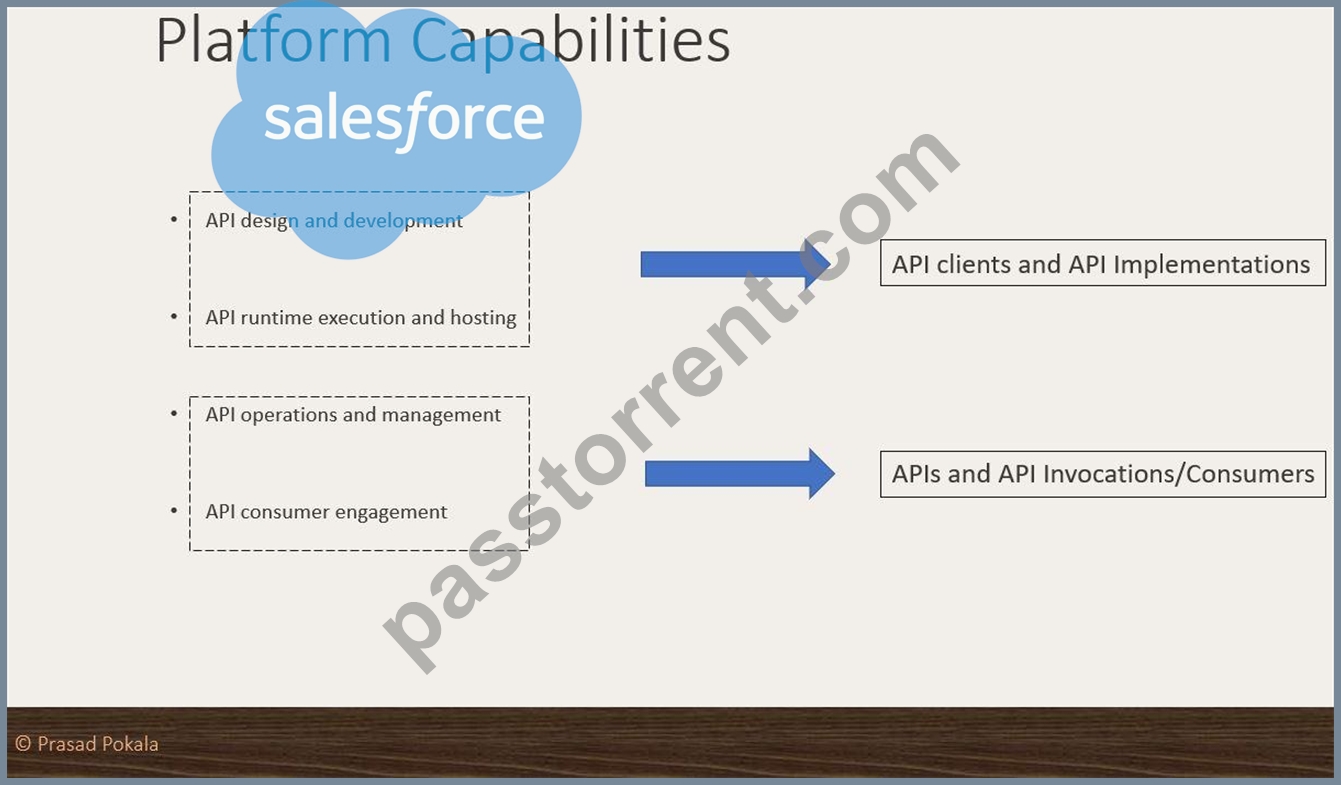
NEW QUESTION # 28
An organization has implemented a Customer Address API to retrieve customer address information. This API has been deployed to multiple environments and has been configured to enforce client IDs everywhere.
A developer is writing a client application to allow a user to update their address. The developer has found the Customer Address API in Anypoint Exchange and wants to use it in their client application.
What step of gaining access to the API can be performed automatically by Anypoint Platform?
- A. Modify the client application to call the API using the client application's credentials
- B. Approve the client application request for the chosen SLA tier
- C. Request access to the appropriate API Instances deployed to multiple environments using the client application's credentials
- D. Create a new application in Anypoint Exchange for requesting access to the API
Answer: B
Explanation:
Correct Answer : Approve the client application request for the chosen SLA tier
*****************************************
>> Only approving the client application request for the chosen SLA tier can be automated
>> Rest of the provided options are not valid
NEW QUESTION # 29
......
Updated Verified MuleSoft-Platform-Architect-I Q&As - Pass Guarantee: https://www.passtorrent.com/MuleSoft-Platform-Architect-I-latest-torrent.html
MuleSoft-Platform-Architect-I Certification with Actual Questions: https://drive.google.com/open?id=13x2EK42fc-ffQPQ81bo3H_V3t1lo0p2D